
You’ve probably seen “ED” in the news this week. Maybe a headline said the ED raided an office or issued a summons. It sounds serious, and it is. But what does it actually stand for? If you’ve searched for the ed long form, you’re in the right place.
ED stands for Enforcement Directorate. It’s a government agency that investigates money crimes. Many people also ask what is ed in politics, since its cases often involve leaders and big businesses. You might also wonder about the ed department itself. And if you’ve heard the term, you may ask about the ed case full form, which we’ll clear up below.
So who does the ED report to? Here’s the quick answer: ed is under which ministry. It works under the Ministry of Finance. We’ll also look at the difference between ed and cbi, because people mix them up all the time. Let’s break it all down in plain English.
Hit by an 18-wheeler in Nashville? An accident attorney who fights trucking companies daily. Free case review, no fee unless you win.
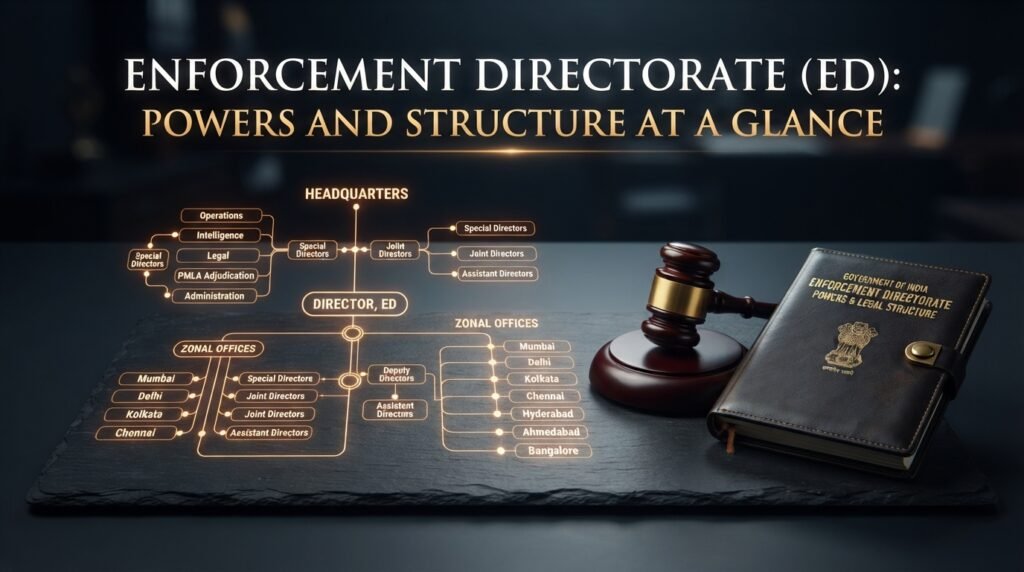
Enforcement Directorate (ED): Powers and Structure at a Glance
Quick Navigation

Short on time? Jump to what you need:
- What the ED is and where it came from
- How it’s organized and who leads it
- Its powers, and the laws behind them
- How an investigation unfolds, step by step
- ED vs. CBI, and ED custody vs. judicial custody
- Criticisms and key court rulings
- Facts worth remembering for exams
What Is the Enforcement Directorate (ED)?

The Enforcement Directorate, also called the Directorate of Enforcement, is a central investigation agency. Its job is to enforce economic laws. In practice, that means chasing money laundering, foreign exchange violations, and large-scale financial fraud. Think of it as the government’s financial detective.
It sits under the Department of Revenue in the Ministry of Finance. Its headquarters are in New Delhi. Here’s something many people miss, though. The ED isn’t a constitutional body. The government created it, and its powers come from specific laws passed by Parliament.
Origins and Evolution of the ED

The story starts in 1956. India set up a small “Enforcement Unit” to handle violations of exchange control rules. A year later, it became the Enforcement Directorate. Back then, the goal was simple: protect the country’s limited foreign currency.
Over the decades, the job changed. India opened its economy in the 1990s, and strict control laws gave way to a more flexible system. FEMA replaced the old FERA in 1999. Then the focus shifted to a bigger problem, dirty money. The Prevention of Money Laundering Act came into force in 2005, and the ED took charge of it. In 2018, the Fugitive Economic Offenders Act added another duty.
How the ED Is Organized

At the top sits the Director of Enforcement. This person is usually an officer from the Indian Revenue Service. Below the Director, the ranks run roughly like this:
- Special Director
- Additional Director
- Joint Director
- Deputy Director
- Assistant Director
Officers come mainly from tax and customs services. Some join on deputation from the police and other departments. The agency works through zonal and sub-zonal offices in major cities, so cases can be handled close to where they happen.
Key Powers and Functions of the ED

The ED doesn’t have one law to enforce. It has several. Each works a little differently:
- PMLA, 2002: A criminal law. The ED investigates money laundering, attaches property tied to it, and can arrest and prosecute.
- FEMA, 1999: A civil law on foreign exchange. Breaking it usually leads to penalties, not jail. Fines can reach up to three times the amount involved.
- FEOA, 2018: Targets people who flee India to dodge trial. The ED can seek to confiscate their assets.
- FERA, 1973: Now repealed. The ED still handles older cases filed under it.
- COFEPOSA, 1974: The ED can sponsor preventive detention cases linked to foreign exchange violations.
The ED also works with agencies in other countries. That’s important, because stolen money rarely stays in one place.
ED Under PMLA and FEMA: Which Laws Give the Agency Its Teeth?
Most headlines trace back to one law, PMLA. It makes money laundering a crime. Specifically, it covers anyone who handles “proceeds of crime” and tries to make that money look clean. The punishment is generally three to seven years in prison.
Here’s a simple example. Say someone takes a bribe and buys a flat in a relative’s name. The bribe is the original crime. Hiding its profits in that flat is the laundering. The ED can step in and trace the money.
FEMA is different. It’s about breaking foreign exchange rules, like sending money abroad without approval. However, it’s a civil law, so the result is usually a fine. That’s why a FEMA case feels very different from a PMLA case.
How an ED Investigation Works, from Summons to Prosecution
Let’s clear up the ed case full form first. It’s the ECIR, or Enforcement Case Information Report. It works like a police FIR, but it’s an internal document. It isn’t public, and the ED doesn’t usually hand it over. Usually, a “predicate offence” comes first, like corruption or fraud registered by another agency. The ED then builds its own money-trail case on top of that.
From there, the process typically moves like this:
- ECIR is recorded. The ED starts looking at the money trail.
- Summons are issued. People are called in to give statements.
- Searches and seizures happen. Officers collect documents, cash, and digital records.
- Property may be attached. Assets seen as proceeds of crime get frozen.
- Arrest can follow, if officers have grounds.
- A complaint is filed. The case goes to a special court for trial.
What Are Your Rights When the ED Summons You?
First, don’t ignore a summons. It comes under Section 50 of PMLA, and skipping it can create bigger trouble. You can, and should, talk to a lawyer. Statements you give can be used as evidence, so be careful and accurate.
If you’re arrested, officers must tell you the grounds in writing. You must also appear before a magistrate within 24 hours. This is general information, not legal advice. If a notice lands in your inbox, speak to a qualified lawyer right away.
How Does the ED Attach and Seize Property Under PMLA?
Attachment means the property gets frozen. You still own it, but you can’t sell or transfer it. Under Section 5, the ED can provisionally attach property it believes is tied to proceeds of crime. That order lasts up to 180 days. An independent Adjudicating Authority must then confirm it.
Seizure is different. It happens during a search, when officers take documents, cash, or valuables on the spot. In short, seizure is immediate. Attachment is a formal order that follows paperwork.
ED vs. CBI: What Sets Them Apart?
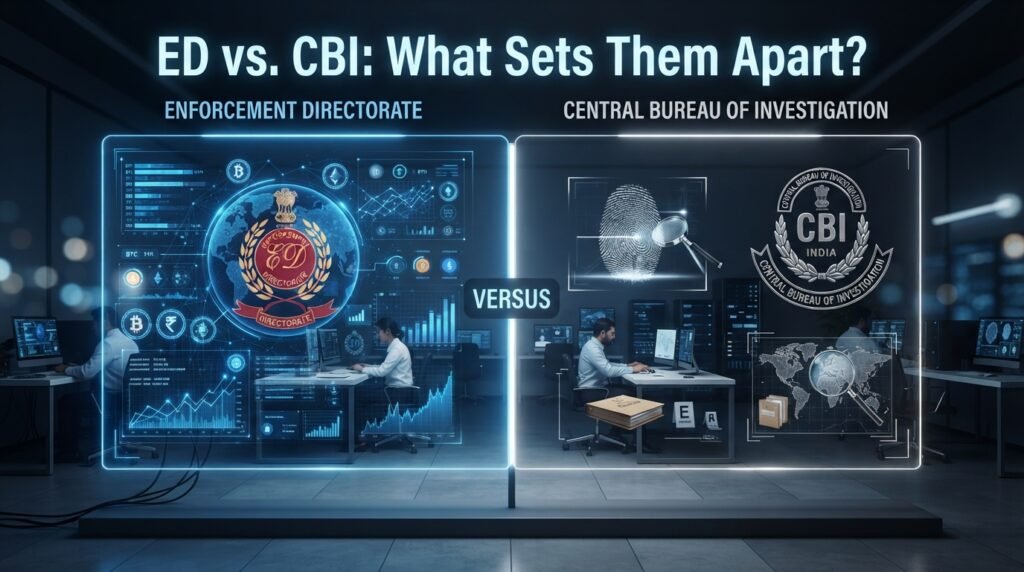
Both agencies investigate big cases, so people confuse them. Their roles differ, though. The table below makes it clearer.
| Point | ED | CBI |
| Main focus | Money laundering, foreign exchange violations | Corruption, serious and multi-state crimes |
| Works under | Department of Revenue, Ministry of Finance | Ministry of Personnel, Public Grievances and Pensions |
| Key laws | PMLA, FEMA, FEOA | Delhi Special Police Establishment Act, Prevention of Corruption Act |
| Case record | ECIR | FIR |
| Head | Director of Enforcement, usually an IRS officer | Director, usually an IPS officer |
The two often overlap. A corruption case might start with the CBI. The ED then follows the money. That’s why one scandal can have both agencies on it.
Judicial Custody vs. ED Custody: What’s the Difference?
The names sound alike, but the meaning is quite different. In ED custody, the agency holds the person for questioning. A court has to approve this remand, and it’s usually for a limited number of days. Officers can use that time to ask questions and check evidence.
Judicial custody means the person is held on a magistrate’s order, usually in jail. The agency can’t question them freely there. Often, a person spends time in ED custody first. Then the court sends them to judicial custody while the case continues.
Common Criticisms of the ED
The ED has strong supporters. They say it’s the only agency equipped to follow complex money trails. Still, critics raise real concerns:
- Political use. Opposition leaders often say the agency targets them. Governments deny it.
- Tough bail rules. PMLA’s bail conditions are strict, so people can stay in custody for long stretches.
- Broad powers. Attachment before trial, critics argue, can hurt people long before guilt is proven.
- Low conviction rates. Many cases get registered, but critics note fewer end in convictions.
Recent Supreme Court Rulings That Shaped ED’s Authority
Two judgments stand out. In Vijay Madanlal Choudhary v. Union of India (2022), the Supreme Court upheld key ED powers, including arrest, attachment, and the strict bail conditions. It also said the ECIR needn’t be shared with the accused. That ruling drew heavy criticism and led to review petitions.
Then came Pankaj Bansal v. Union of India (2023). The Court said arrested people must be given the written grounds of arrest. It was a clear win for personal rights. Together, these cases show the balance courts keep trying to strike.
ED Important Questions and Facts for UPSC and Other Competitive Exams
Preparing for an exam? Keep these points handy:
- The ED began in 1956 and got its current name in 1957.
- It works under the Department of Revenue, Ministry of Finance.
- It’s a statutory, not constitutional, body.
- PMLA is a criminal law. FEMA is a civil law.
- ECIR is the ED’s case record, not an FIR.
- FEMA penalties can reach three times the amount involved.
- The Fugitive Economic Offenders Act came in 2018.
Common exam angles include ED vs. CBI, PMLA’s key sections, and the Supreme Court rulings above. Understand the “why” behind each, and you’ll remember it better than rote learning.
Final Thoughts on the Enforcement Directorate
The ED has grown from a small foreign exchange unit into one of India’s most powerful financial agencies. Its reach now spans money laundering, forex violations, and fugitive offenders. It has also become one of the most debated institutions in the country. Supporters see a necessary watchdog. Critics see a power that needs tighter checks.
Whichever side you lean toward, knowing the basics helps. You’ll read the news with sharper eyes, and you’ll know what each term means.
Share Your Thoughts
What’s your take on the ED’s powers? Do they strike the right balance? Drop your views in the comments.
FAQs
What is the ed long form?
ED stands for Enforcement Directorate, also called the Directorate of Enforcement. It investigates money laundering and foreign exchange violations.
ED is under which ministry?
The ED works under the Department of Revenue in the Ministry of Finance. Its headquarters are located in New Delhi.
What is ED case full form?
ECIR stands for Enforcement Case Information Report. It’s the ED’s internal record of a case, similar to a police FIR.
What is the difference between ED and CBI?
The ED probes money laundering and forex offences. The CBI handles corruption and serious crimes. They report to different ministries.
Who is the head of ED?
The Director of Enforcement heads the agency and is usually an IRS officer. Special, additional and joint directors also assist.
Can the ED arrest without a warrant?
Yes. PMLA’s Section 19 lets officers arrest without a warrant if they record written reasons and share the arrest grounds.
What is hawala, and why does the ED track it?
Hawala is an informal money transfer system without bank records. The ED tracks it because it often hides illicit funds.
Conclusion:
So, that’s the full picture. The ed long form is Enforcement Directorate, a central agency that tracks money crimes. It’s no longer just a name in a headline. You now know what it does and how it works.
Along the way, you saw what is ed in politics explained. Its cases often involve public figures, so it stays in the spotlight. You also learned that ed is under which ministry. It sits within the Ministry of Finance. The ed department has grown a lot since 1956, and its role keeps expanding.
Next time you read a news story, you’ll spot the details. An ed case full form is ECIR, its own case record. And the difference between ed and cbi is simple. One follows the money trail. The other handles broader crimes. Keep learning, stay curious, and share this guide with a friend who’s still confused.
ed long form ed long form ed long form ed long form ed long form ed long form ed long form ed long form ed long form ed long form ed long form ed long form ed long form ed long form ed long form ed long form ed long form ed long form
3 thoughts on “Enforcement Directorate (ed long form): Powers, Structure & How It Works”