
Ever heard a court say “302 read with 34” and wondered what that “34” is doing there? You’re not alone. Most people hear it in news reports and never get a clear answer. So let’s fix that. If you’ve searched “धारा 34 क्या है,” this guide is for you.
IPC 34 deals with crimes done by a group. When several people commit a crime together with a shared plan, each one is treated as if they did the whole thing. Even if you didn’t strike the final blow, you can still be held responsible.
Of course, a few more questions come up fast. What is the 34 ipc punishment? Is 34 ipc bailable or not? And what is 34 ipc in BNS now that the law has changed? We’ll cover all of it, step by step.
ED long form, powers, and how a case really works. See who the Enforcement Directorate answers to and how it differs from the CBI.
Section 34 IPC: Meaning, Purpose, Punishment, and Key Differences
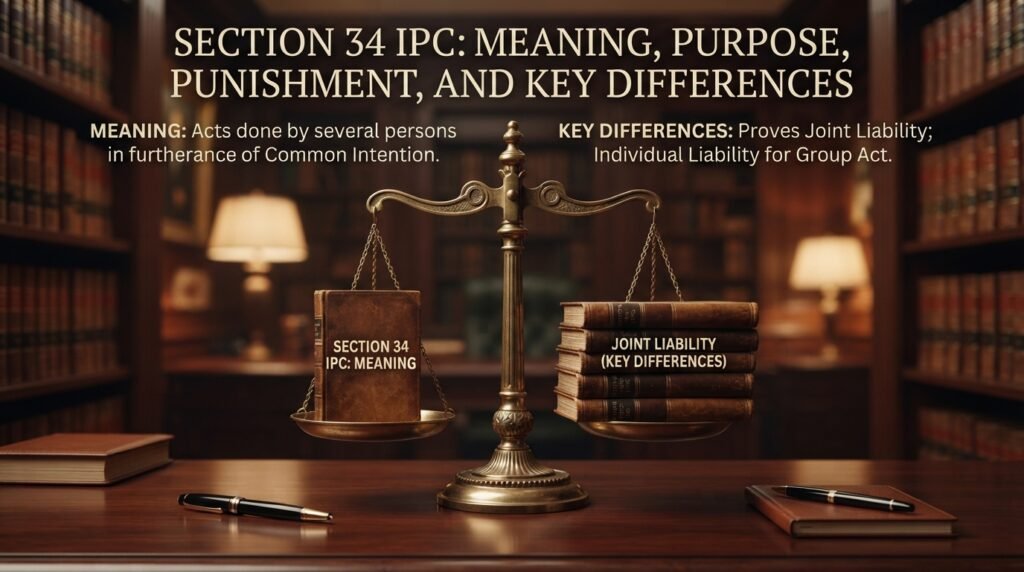
Section 34 is only one sentence long. Yet it shows up in a huge number of criminal judgments in India. Why? Because crimes often involve more than one person, and courts need a fair way to decide who’s responsible for what.
This guide walks you through the meaning, the punishment, the bail question, and the BNS change. You’ll also see how Section 34 differs from Section 149, plus a few real-life examples.
Table of Contents

- What Is Section 34 of the Indian Penal Code?
- Why Section 34 Exists
- Punishment Under Section 34 IPC
- Common Intention vs. Common Object
- Joint Criminal Liability and Common Intention
- Landmark Judgments on Section 34
- Key Elements Needed to Prove Common Intention
- Real-Life Examples
- Is Section 34 IPC Bailable?
- Section 34 IPC vs. Section 3(5) BNS
- Common Defenses
- FAQs
What Is Section 34 of the Indian Penal Code?

The Indian Penal Code, 1860 uses Section 34 to deal with acts done by several persons in furtherance of a common intention. In plain words: if a group commits a criminal act together and they all shared the same plan, each person is liable as if they’d done it alone.
Picture three friends planning to rob a jewelry store. One breaks the lock, one keeps watch outside, and one empties the cases. Only one of them touched the jewelry. Still, all three can be held responsible for the robbery.
Here’s the catch, though. Section 34 isn’t an offence on its own. You’ll never see someone charged under “Section 34” alone. It always travels with another section, like murder under Section 302. That’s why you hear “302 read with 34.”
Why Section 34 Exists

Group crimes are messy. They happen fast, often at night, and witnesses rarely agree on who did what. Without a rule like this, the person who landed the fatal blow might be convicted while the others walk free.
Section 34 fixes that gap. If you shared the plan and played a part, you share the blame. The prosecution doesn’t have to prove exactly whose hand did what. It has to show the group acted together toward one shared goal.
Punishment Under Section 34 IPC

Here’s something many articles get wrong. Section 34 has no punishment of its own. It simply decides who’s liable, and the sentence comes from the main offence.
So the 34 ipc punishment depends on the crime:
- Murder (Section 302): death or life imprisonment, plus a fine.
- Attempt to murder (Section 307): up to 10 years and a fine, with life imprisonment possible if someone is hurt.
- Other offences: whatever that specific section prescribes.
Each convicted person gets the sentence for the main offence. However, judges still consider individual circumstances, like age or criminal record, when deciding the final sentence.
Common Intention vs. Common Object: What’s the Difference?
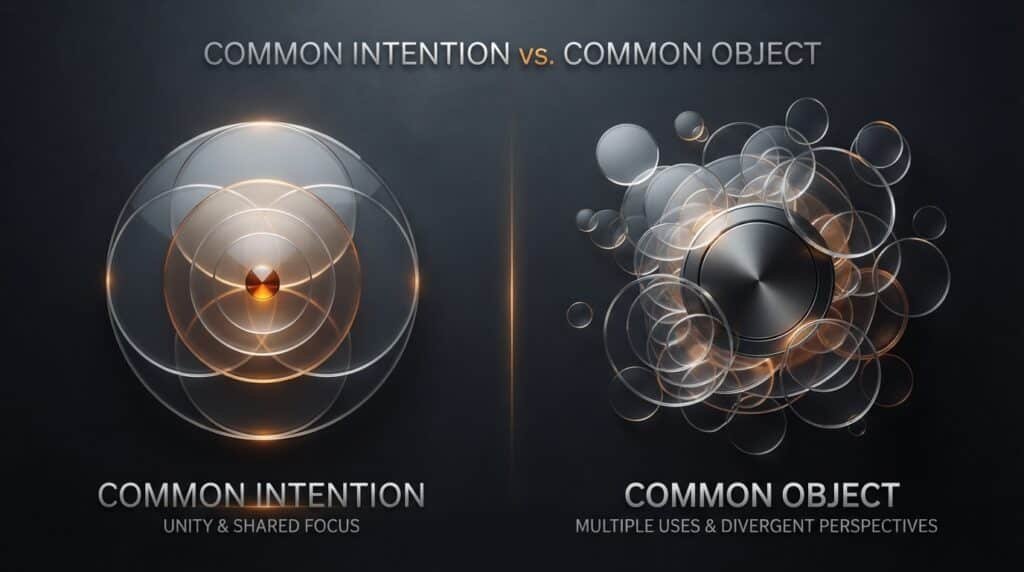
Students mix these up all the time. Common intention belongs to Section 34. Common object belongs to Section 149, which covers unlawful assembly. Both create group liability, but they work differently.
| Basis | Section 34 (Common Intention) | Section 149 (Common Object) |
| Group size | Two or more people | Five or more people |
| Core idea | A shared plan or mindset | A shared goal of an unlawful assembly |
| Prior agreement | A meeting of minds is required, though it can form on the spot | Doesn’t need a plan in the same sense; the object can also form suddenly |
| Role of the accused | Some participation in the act is needed | Simply being a member of the assembly can be enough |
| Liability | For the act done in furtherance of the shared intention | For offences committed to achieve the object, or ones members knew were likely |
Think of it this way. Section 34 asks, “Did you plan this with them and take part?” Section 149 asks, “Were you part of that unlawful crowd?”
Joint Criminal Liability and Common Intention

Lawyers call this idea joint criminal liability. You’ll also hear terms like constructive liability or vicarious liability. The basic principle is simple. When a group acts together with one purpose, the law treats each member’s act as the act of everyone.
But there’s a limit. You’re liable only for what the shared plan covered. Suppose two men plan to beat someone up. One suddenly pulls out a knife and kills the victim. The other man may argue he never agreed to murder. Courts look closely at exactly what the group intended, not just what ended up happening.
Landmark Judgments on Section 34
A handful of cases shaped how courts read this section today:
- Barendra Kumar Ghosh v. King Emperor (1925): The Privy Council held that a person who was present with the group, even without firing, could be liable. Taking part doesn’t always mean striking the blow.
- Mahbub Shah v. King Emperor (1945): The Privy Council stressed that common intention differs from the same or similar intention. Several people can want the same result without having planned it together.
- Pandurang v. State of Hyderabad (1955): The Supreme Court of India explained that a prior meeting of minds is needed. It also noted that the plan can form quickly, even moments before the act.
- Ramaswami Ayyangar v. State of Tamil Nadu (1976): The Court reinforced that shared intention and participation must be shown, not merely assumed.
- Virendra Singh v. State of Madhya Pradesh (2010): The Court revisited the key principles and again separated common intention from similar intention.
Key Elements Needed to Prove Common Intention Under Section 34
For a Section 34 charge to stick, the prosecution generally has to prove these points:
- A criminal act was actually done.
- Two or more people were involved.
- They shared a common intention, meaning a prior meeting of minds or a pre-arranged plan.
- The accused took part in the criminal act in some way.
- The act was done in furtherance of that shared intention.
Direct proof of a plan is rare. Nobody signs a contract before committing a crime. So courts usually rely on circumstantial evidence and eyewitness testimony. They look at how the group arrived, what they carried, how they behaved during the act, and how they left. The burden of proof stays with the prosecution throughout.
Can Someone Be Convicted Under Section 34 Without Taking Part in the Act?
Short answer: you don’t have to land the blow, but you do have to take part. Standing guard, driving the getaway vehicle, or blocking the victim’s escape can all count as participation.
However, being at the scene isn’t enough. Neither is knowing a crime might happen. If you just happened to be nearby, or you knew but never joined the plan, Section 34 shouldn’t apply. Someone who helps from a distance, say by supplying a weapon, may face abetment charges instead.
Section 34 IPC in Real Life: Examples and Case Scenarios
Let’s make this concrete with three quick scenarios.
The planned attack. Four men decide to attack a rival outside his shop. They arrive together, surround him, and one of them stabs him fatally. All four can face murder charges under Section 302 read with Section 34, since the attack was a team effort.
The robbery that went wrong. Two people plan only to rob a shopkeeper. During the struggle, one kills him. Here, the court asks whether the other person shared an intention to kill, or only to rob. The answer may change which charge each person faces.
The cheating case. Three people run a fake investment scheme together and collect money from victims. Section 34 often gets paired with Section 420 here, because everyone worked toward the same fraud, even if only one handled the cash.
Is Section 34 IPC Bailable? How Bail Works in Joint Offences
So, is 34 ipc bailable or not? There’s no single answer, because Section 34 doesn’t create an offence. Bail depends entirely on the main crime attached to it.
If the group is charged with murder, the offence is cognizable and non-bailable, and the trial happens in a sessions court. Bail then isn’t a right. The court decides after weighing the seriousness of the crime, the evidence in the FIR and charge sheet, and the risk of the accused fleeing or tampering with witnesses. For a lesser offence like simple hurt, bail is generally easier to get. Always check the main section first.
Section 34 IPC vs. Section 3(5) BNS: What Changed After 2024?
The Bharatiya Nyaya Sanhita, 2023 replaced the IPC on July 1, 2024. So what’s 34 ipc in BNS? It’s now Section 3(5). The wording is essentially the same, and so is the meaning. If you understand Section 34, you already understand Section 3(5).
A few practical points:
- Offences committed before July 1, 2024 are still dealt with under the IPC.
- Older case laws on Section 34 continue to guide courts under the new section.
- Procedure now follows the Bharatiya Nagarik Suraksha Sanhita, which replaced the Code of Criminal Procedure.
- Related sections have new numbers too. Murder is Section 103, unlawful assembly liability is Section 190, and criminal conspiracy is Section 61.
Common Defenses Against a Section 34 Charge
If someone is accused under Section 34, a defense lawyer typically tries one of these routes:
- No shared intention. The accused never agreed to the plan, and any similarity in actions was coincidence.
- No participation. The person was only present, or arrived after the act.
- A different plan. The act went far beyond what the group had intended.
- Weak evidence. The witnesses contradict each other, the FIR was delayed, or the accused was falsely named.
Of course, the right strategy depends on the facts of each case. If you or someone you know faces such a charge, talk to a qualified criminal lawyer.
FAQs
What is IPC 34 in simple words?
IPC 34 makes every person in a group equally liable when they commit a crime together with a shared plan.
What is 34 IPC in BNS?
It’s Section 3(5) of the Bharatiya Nyaya Sanhita, which took effect on July 1, 2024, with essentially the same meaning.
What is the 34 IPC punishment?
Section 34 has no separate punishment. Each person gets the sentence for the main offence, like murder under Section 302.
Is 34 IPC bailable or not?
It depends on the main offence. Murder with Section 34 is non-bailable, while minor offences like simple hurt are bailable.
What is the difference between Section 34 and Section 149 IPC?
Section 34 needs shared intention among two or more people. Section 149 needs five or more in an unlawful assembly.
Can you be convicted under Section 34 if you didn’t commit the act yourself?
Yes, if you shared the plan and took part, even by standing guard. Mere presence or knowledge alone isn’t enough.
How do courts prove common intention under IPC 34?
Courts infer it from conduct, like arriving together, carrying weapons, and acting in coordination. Direct proof is very rarely available.
Conclusion:
So, what’s the takeaway? IPC 34 is simple at its core. When people commit a crime together with a shared plan, the law holds each of them responsible. If you came here asking “धारा 34 क्या है,” you now have a clear answer.
A few details matter most. The 34 ipc punishment isn’t separate. It comes from the main offence, like murder or robbery. And is 34 ipc bailable or not? That depends on the crime it’s paired with. A serious charge usually means bail is harder to get.
The law has moved forward, too. Today, 34 ipc in BNS is Section 3(5), and the meaning stays the same. Keep the basics in mind: a shared plan, real participation, and an act done together. Once you’ve got those, 34 ipc stops feeling confusing. It starts making sense.
ipc 34 ipc 34 ipc 34 ipc 34 ipc 34 ipc 34 ipc 34 ipc 34 ipc 34 ipc 34 ipc 34ipc 34ipc 34 ipc 34 ipc 34 ipc 34 ipc 34
2 thoughts on “IPC 34 Explained: Meaning, Punishment, Bail, and BNS Equivalent”