
The Shah Bano Case Explained

Some cases change a country’s conversation overnight. The Shah Bano Case did exactly that. It started as a small money dispute between an elderly woman and her ex-husband. It ended up in India’s highest court, then in Parliament, and then in political debates that still pop up today.
A quick note before we dive in. Plenty of people search for the “Shazia Bano case” or the “real Shazia Bano.” They mean Shah Bano Begum. The spelling gets mixed up often, so if you came here for the Shazia Bano story, you’re in the right place.
That is, overturned the Act’s limitation after Shah Bano’s case.
Table of Contents
- Why the case matters
- Facts of Shah Bano’s case
- Issues before the Supreme Court
- What iddat means
- The 1985 judgment
- Key observations by the Court
- Section 125 CrPC vs. Muslim Personal Law
- Danial Latifi and the 1986 Act
- Impact of the case
- Parliament’s response
- Conclusion
- Shah Bano case and the Uniform Civil Code debate
- Quick revision points
- FAQs
Why Is the Shah Bano Case Important?

Think about a woman in her sixties. She has no income and no home. Her husband of forty-odd years has just ended the marriage. Who should support her? That was the heart of the matter.
The Shah Bano maintenance case put that question in front of the whole country. It tested whether a secular law could protect a divorced Muslim woman. It also pushed three big debates into the open: women’s rights, religious freedom, and the idea of one common civil code. That’s why law students, UPSC aspirants, and everyday readers keep coming back to it.
Facts of Shah Bano’s Case
Shah Bano Begum lived in Indore, Madhya Pradesh. She married Mohammad Ahmed Khan, a successful lawyer, in 1932. They had five children. Around 1975, he asked her to leave the family home, and she was left without steady support.
In 1978, she went to a magistrate and asked for maintenance under Section 125 of the Code of Criminal Procedure. She wanted Rs. 500 a month. Her husband responded with an irrevocable triple talaq. He argued that she was no longer his wife, so Section 125 didn’t apply. He also said he’d paid Rs. 200 a month for about two years and had deposited Rs. 3,000 as mehr (dower).
Here’s how the case moved through the courts:
- 1979: The magistrate ordered Rs. 25 a month.
- 1980: The Madhya Pradesh High Court raised it to Rs. 179 a month.
- 1985: Her husband appealed to the Supreme Court, which heard the matter before a Constitution Bench.
Issues Before the Supreme Court
The Court had a few thorny questions to sort out. None of them were simple. Together, they decided whether a divorced Muslim woman could use a law meant for every citizen.
- Does the word “wife” in Section 125 CrPC include a divorced Muslim woman?
- Does Section 125 override Muslim Personal Law when the two seem to clash?
- Is a husband’s duty to pay mehr and iddat maintenance enough to end his responsibility?
- How should Section 127(3)(b) CrPC be read in this context?
The husband’s side was blunt. Muslim law, they said, ends a man’s duty after he pays the mehr and supports his ex-wife through the iddat period. The All India Muslim Personal Law Board backed that view. In their eyes, courts shouldn’t step into matters covered by Shariat.
What Is Iddat?
Iddat is a waiting period a Muslim woman observes after divorce or her husband’s death. During this time, she can’t remarry. Traditionally, it helps confirm whether she’s pregnant, and it gives her space to process the loss.
The length depends on the situation:
- After divorce: About three months.
- After a husband’s death: Four months and ten days.
- If she’s pregnant: Until the child is born.
Why does this matter here? Because the husband argued his responsibility ended once iddat did. Shah Bano’s lawyers said that wasn’t enough for a woman who couldn’t support herself afterward.
Shah Bano Case Judgment
In April 1985, the Supreme Court gave its ruling. Chief Justice Y.V. Chandrachud, leading the bench, sided with Shah Bano. The Court held that Section 125 CrPC applies to all citizens, whatever their religion. A divorced Muslim wife who can’t support herself could claim maintenance. The Court also raised the amount, though the final order stayed modest.
The ruling’s logic was simple. Section 125 isn’t about religion. It’s about stopping a person from falling into destitution. So if a husband has the means and his ex-wife doesn’t, the law steps in. Personal law couldn’t stand in the way of that safety net.
Key Observations Made by the Supreme Court
Beyond the verdict itself, the judges made several remarks that people still quote.
- Section 125 is a quick remedy for those who can’t maintain themselves, and religion doesn’t change that.
- The duty to support indigent relatives comes from a person’s obligation to society.
- The Court read Quranic verses on provision for divorced women and argued they didn’t conflict with Section 125.
- It urged the government to move toward a Uniform Civil Code under Article 44.
That last point lit the fuse. Critics felt the Court had stepped beyond its role by commenting on religious texts.
Section 125 CrPC vs. Muslim Personal Law: The Core Legal Clash
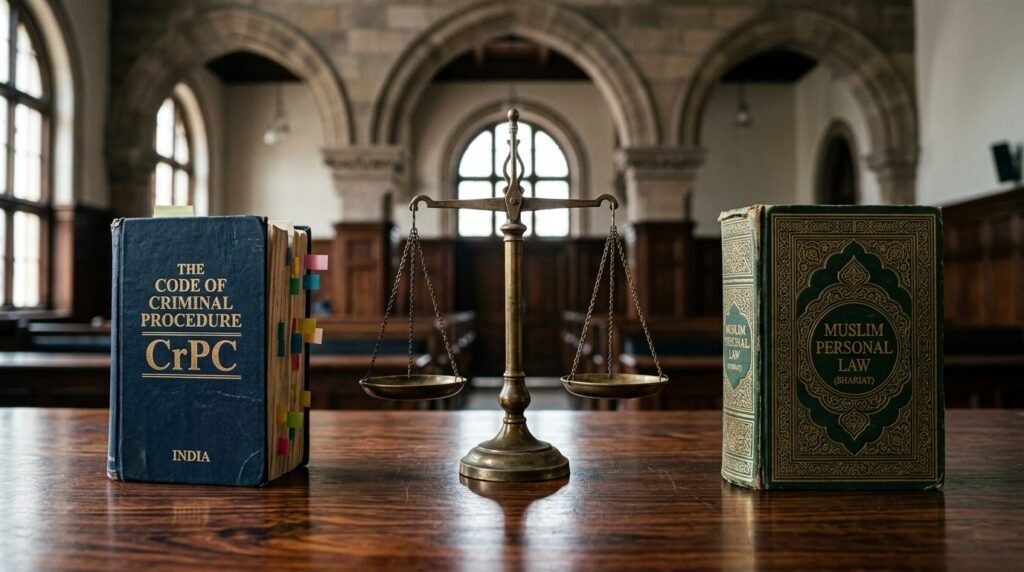
Picture two rulebooks sitting on the same shelf. One is a criminal procedure law that applies to everyone. The other is a personal law that governs marriage and divorce for one community. The Shah Bano case asked which one wins when they seem to say different things.
The Court’s answer was that they didn’t truly conflict. Section 125 offers a basic, secular safety net, while personal law covers other rights. However, many in the community saw it differently. They argued the ruling blurred a line between civil law and religious practice. That disagreement shaped everything that followed, including the debate on personal law vs. secular law that you still hear now.
Danial Latifi v. Union of India: How the Court Read the 1986 Act
Years later, the 1986 law itself landed in the Supreme Court. In Danial Latifi v. Union of India (2001), a Constitution Bench upheld the Act’s validity. Then it did something clever. It read the law in a way that protected divorced Muslim women much better than the text first suggested.
The Court said the husband must make a “reasonable and fair provision” for his ex-wife’s future during the iddat period. In other words, he can’t just cover three months of expenses and walk away. If he doesn’t, she can approach a magistrate. In practice, this quietly revived much of what the Shah Bano judgment had offered.
What Was the Impact of the Shah Bano Case?
The impact went well beyond one woman’s monthly allowance. Politically, it created one of the sharpest controversies of the 1980s. Socially, it forced families, lawmakers, and religious leaders to talk about divorce and dignity in public. Legally, it showed how far courts could go in protecting women’s rights using general laws.
There was a personal cost too. Shah Bano faced enormous pressure after the ruling and later said she was withdrawing her claim. Many see that as one of the saddest turns in the whole story.
How Parliament Responded: The Muslim Women (Protection of Rights on Divorce) Act, 1986
Under the Rajiv Gandhi government, Parliament passed the Muslim Women (Protection of Rights on Divorce) Act in 1986. It effectively overrode the Supreme Court’s decision for Muslim women. The law mainly tied maintenance to the iddat period and shifted responsibility to relatives or the Waqf Board after that.
Not everyone agreed with the move. Minister Arif Mohammed Khan resigned in protest. Women’s groups and many legal experts criticized the Act as a step backward. Supporters, on the other hand, said it respected community sentiment. Either way, the 1986 Act remains one of the most debated laws in modern India.
Shah Bano Case and the Uniform Civil Code Debate
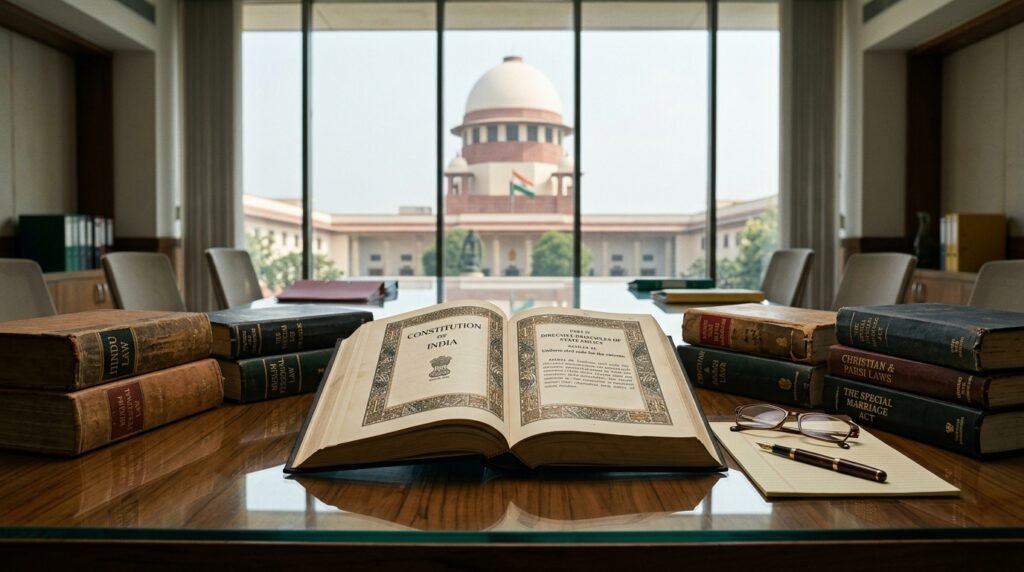
Chief Justice Chandrachud’s remarks on Article 44 turned a maintenance dispute into a national talking point. Article 44 sits among the Directive Principles of State Policy. It says the state should “endeavor” to secure a common civil code. Supporters of a UCC pointed to Shah Bano as proof that personal laws can leave women exposed.
Opponents saw it differently. They worried a single code could weaken minority rights guaranteed under Article 25. They also felt reform should come from within communities. Decades later, the argument hasn’t gone away. Whenever the UCC returns to the headlines, Shah Bano’s name usually isn’t far behind.
Shah Bano Case Summary for UPSC and Law Exams: Quick Revision Points
Short on time? Here’s a cheat sheet you can skim before an exam.
- Case name: Mohd. Ahmed Khan v. Shah Bano Begum (1985)
- Court: Supreme Court of India, Constitution Bench
- Bench led by: Chief Justice Y.V. Chandrachud
- Main law: Section 125 of the Code of Criminal Procedure
- Holding: Section 125 applies to divorced Muslim women who can’t maintain themselves
- Follow-up law: Muslim Women (Protection of Rights on Divorce) Act, 1986
- Later case: Danial Latifi v. Union of India (2001)
- Constitutional links: Article 14, Article 25, and Article 44
Here’s a tip for answer writing. Don’t just list the facts. Connect the case to bigger themes like gender justice, secularism, and the personal law vs. secular law debate. Examiners reward that kind of thinking.
FAQs on the Shah Bano Case
Who is the real Shazia Bano people search for in the Shah Bano case?
People usually mean Shah Bano Begum, the Indore woman who sought maintenance. “Shazia Bano” is just a very common misspelling.
What did the Supreme Court decide in the Shah Bano case judgment?
In 1985, the Court held that Section 125 CrPC covers divorced Muslim wives, so Shah Bano received maintenance beyond iddat.
Why did the Shah Bano case cause a political controversy?
Some religious leaders saw the ruling as interference in Muslim Personal Law, and the Rajiv Gandhi government legislated in response.
How did the 1986 Act change the Shah Bano case outcome?
It limited maintenance to the iddat period, effectively diluting the ruling, until Danial Latifi later read it far more generously.
Did the Shah Bano case lead to a Uniform Civil Code?
No. The Court urged Parliament to pursue Article 44, but the Uniform Civil Code debate continues without a national law.
Can divorced Muslim women claim maintenance under Section 125 today?
Yes. In 2024, the Supreme Court confirmed divorced Muslim women can claim maintenance under secular law alongside the 1986 Act.
Is the Shah Bano case important for UPSC and law exams?
Absolutely. Examiners love it because it links Section 125 CrPC, personal laws, Article 44, and gender justice in one case.
Conclusion:
That’s the real Shazia Bano story. Her name was Shah Bano Begum, and she asked for basic support. Nothing more. Yet the Shah Bano Case ended up reshaping how India talks about law, faith, and women’s rights.
Her husband said religion ended his duty. The Supreme Court disagreed. Parliament later softened that ruling, and courts restored much of it. So if you searched for the Shazia Bano case or the Shazia Bano husband, you now know how it all played out.
Why does it still matter? Because the questions haven’t gone away. Who protects a woman after divorce? Where does personal law end and equal rights begin? Keep those in mind when you read news about the Uniform Civil Code. You’ll spot Shah Bano’s shadow everywhere. Her fight was never wasted. It’s still teaching us something valuable, even decades later.
Shah Bano Case Shah Bano Case Shah Bano Case