
Reservation in India is one of the most discussed policies in the country. It’s also one of the most misunderstood. Some people see it as a fair fix for old injustices. Others see it as a source of new tensions. Either way, you can’t follow Indian politics, education, or public jobs without understanding it.
This guide keeps things simple. You’ll see where reservation came from, what the Constitution says, which amendments reshaped it, and how the courts keep drawing its limits.
IPC 34 in plain English: what it means, how punishment works, if it’s bailable, and its new BNS section number.
Table of Contents
- Why the reservation system was introduced
- Reservation as affirmative action
- Evolution before and after independence
- Reservation under the Constitution
- Constitutional amendments
- Reservation percentage by category
- Key constitutional articles
- Landmark judgments
- How it works in practice
- EWS quota and state-level rules
- Current debates and the creamy layer
- Myths vs. facts
- Conclusion and FAQs
Why Was the Reservation System Introduced in India?
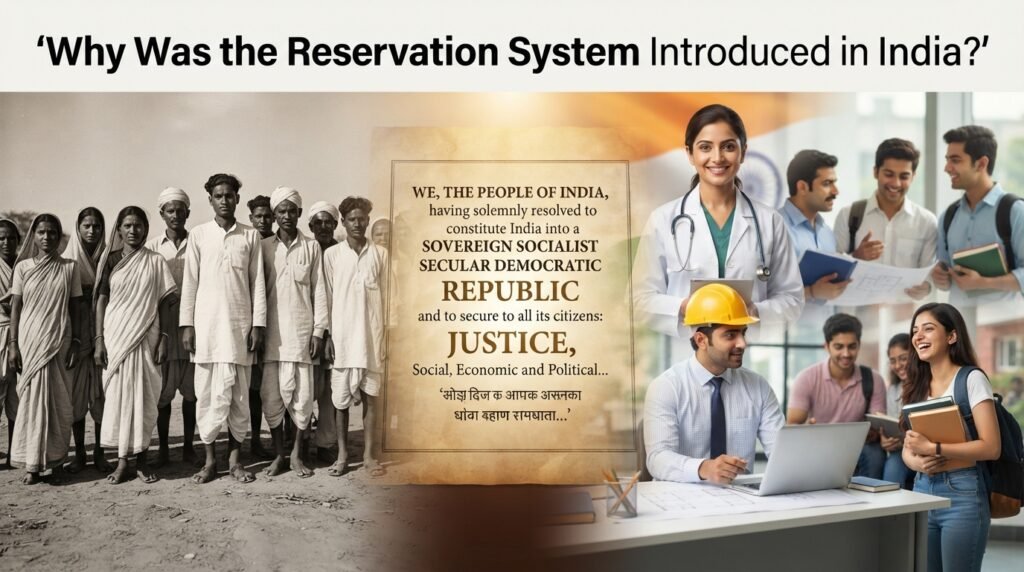
Picture a race where some runners start 100 meters behind the line. Announcing “everyone’s equal now” doesn’t fix that. India’s founders understood this. For centuries, caste kept millions of people away from schools, land, temples, and jobs. Independence didn’t erase that overnight.
So reservation had a few clear goals:
- Make up for generations of social exclusion
- Give underrepresented groups a real voice in public institutions
- Open doors to education and government jobs
- Level the field so merit has a fair chance to show
Reservation as Affirmative Action: What It Really Means

Reservation is India’s version of affirmative action. It sets aside a share of seats and posts for groups that faced long-term discrimination. The idea isn’t to punish anyone. It’s to correct a lopsided starting point.
Today, the main beneficiary groups are:
- Scheduled Castes (SC)
- Scheduled Tribes (ST)
- Other Backward Classes (OBC)
- Economically Weaker Sections (EWS)
One detail trips people up. Legislative seat reservation applies only to SCs and STs. OBCs and EWS don’t get reserved seats in Parliament or state assemblies.
How Reservation Evolved Before and After Independence
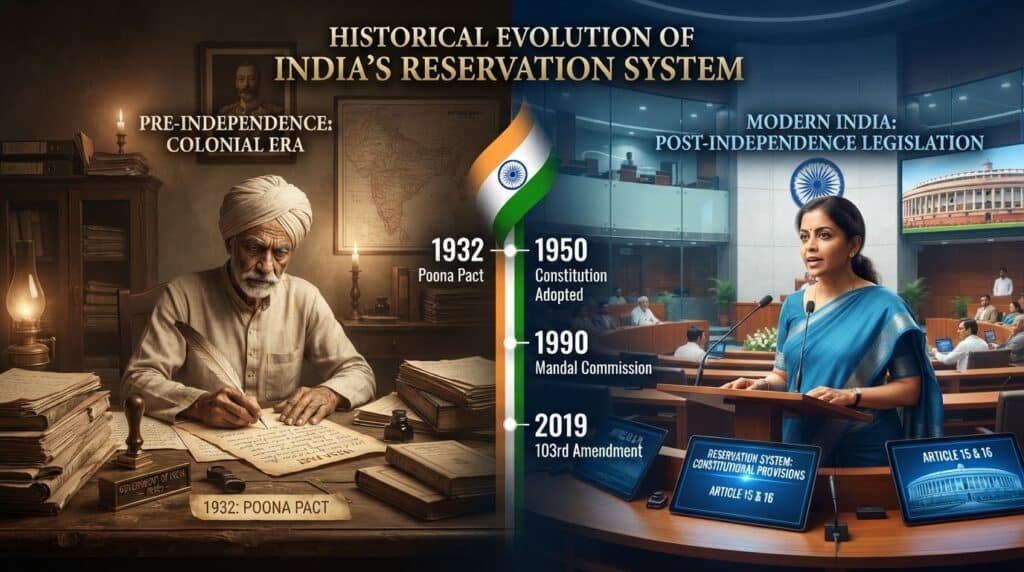
So, when did reservation start in India? The honest answer is that it grew in stages.
In 1882, social reformer Jyotirao Phule urged the Hunter Commission to provide free, compulsory education and fair representation in government jobs. Then in 1902, Shahu Maharaj of Kolhapur reserved 50% of state posts for backward communities. Many historians treat this as the first formal reservation order.
British rule added its own chapters. A 1908 policy favored communities with little presence in administration. The Madras Presidency issued a detailed communal order in 1921. The Government of India Acts of 1909, 1919, and 1935 slowly built in group representation. The 1932 Poona Pact, signed by Dr. B.R. Ambedkar and Mahatma Gandhi, then secured reserved legislative seats for the “depressed classes.”
After 1947, Ambedkar and the Constituent Assembly treated reservation as a correction mechanism, not charity. The Constitution came into force on January 26, 1950, and gave the policy legal backing.
Reservation Under the Indian Constitution
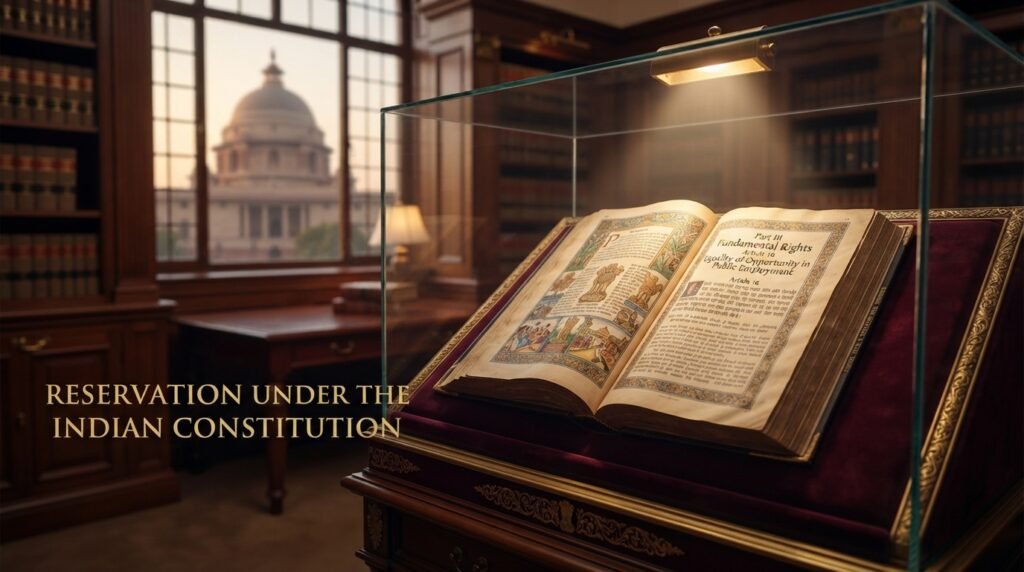
Several provisions form the backbone of the policy. Here’s what each one does:
- Article 14 guarantees equality before the law.
- Article 15(4) lets the State make special provisions for socially and educationally backward classes, SCs, and STs.
- Article 16(4) allows reservation in public jobs for backward classes that lack adequate representation.
- Article 46 directs the State to promote the educational and economic interests of weaker sections.
Notice the wording. These are “enabling” provisions. The State may reserve seats, but nothing forces it to.
Constitutional Amendments Related to Reservation in India
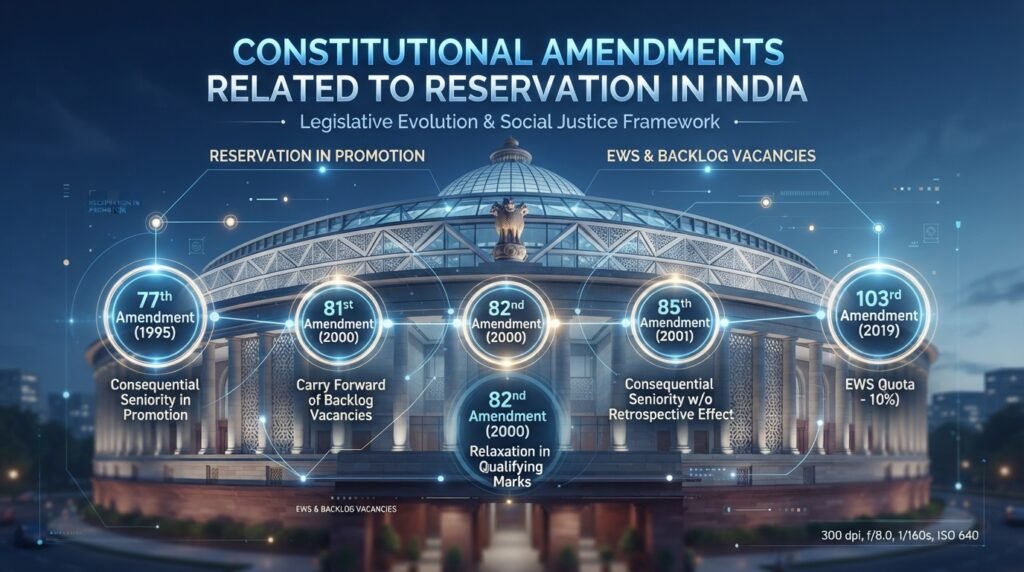
Each amendment below answered a court ruling or a gap in the law. Here’s the quick view:
| Amendment | What triggered it | What it changed |
| 1st (1951) | Champakam Dorairajan struck down caste-based seats in colleges | Added Article 15(4) |
| 77th (1995) | Indra Sawhney barred reservation in promotions | Added Article 16(4A) for SC/ST promotions |
| 81st (2000) | Unfilled SC/ST vacancies couldn’t be carried forward freely | Added Article 16(4B), letting backlog posts sit outside the 50% cap |
| 85th (2001) | Disputes over seniority after reserved promotions | Gave “consequential seniority” to SC/ST employees |
| 93rd (2005) | Doubt over quotas in private unaided colleges | Added Article 15(5) (minority institutions excluded) |
| 103rd (2019) | Demand for help based on economic need | Added 10% EWS quota via Articles 15(6) and 16(6) |
| 104th (2019) | Legislative quotas were nearing their deadline | Extended SC/ST seat reservation to 2030; ended nominated Anglo-Indian seats |
| 106th (2023) | Low women’s presence in legislatures | Promised one-third seats for women (Nari Shakti Vandan Adhiniyam) |
The Supreme Court later upheld the 77th, 81st, and 85th Amendments in M. Nagaraj. However, it added a catch. Before granting promotion quotas, the State must show the group’s backwardness and inadequate representation. It must also show that administrative efficiency won’t suffer.
Reservation Percentage in India by Category
For direct recruitment and admissions at the central level, the split looks like this:
- SC: 15%
- ST: 7.5%
- OBC (non-creamy layer): 27%
- EWS: 10%
Add them up and you get 59.5%. That’s above the 50% ceiling the Court set earlier. We’ll come back to that tension shortly.
Where did these numbers come from? The Kaka Kalelkar Commission (1953) made the first attempt to identify backward classes, but the government shelved its report. Then the Mandal Commission, set up in 1979, estimated that OBCs made up about 52% of the population and recommended a 27% quota. The government acted on that in 1990, which led straight to the Indra Sawhney case.
Key Articles of the Constitution on Reserved Categories
Beyond the big four, several other articles quietly do a lot of work:
- Article 15(5): Quotas in private unaided educational institutions
- Article 16(4A) and 16(4B): Promotions and carry-forward of vacancies
- Articles 330 and 332: Reserved SC/ST seats in the Lok Sabha and state assemblies
- Articles 243D and 243T: Reserved seats in panchayats and municipalities
- Article 335: SC/ST claims to services, balanced with administrative efficiency
- Articles 341 and 342: The President notifies which communities count as SC or ST
- Articles 338, 338A, and 338B: National commissions for SCs, STs, and backward classes
- Fifth Schedule: Governance of Scheduled Areas and Tribes Advisory Councils
Quick note: the National Commission for Backward Classes got constitutional status through the 102nd Amendment, which is why Jaishri Patil later limited what states could do on their own.
Timeline of Landmark Judgments on Reservation
Courts have shaped reservation as much as Parliament has. These are the rulings worth knowing:
| Case | Year | Why it matters |
| State of Madras v. Champakam Dorairajan | 1951 | Struck down caste-based college quotas, triggering the 1st Amendment |
| M.R. Balaji v. State of Mysore | 1962 | Hinted at a 50% limit; said caste alone can’t define backwardness |
| T. Devadasan v. Union of India | 1964 | Struck down the “carry forward” rule as then framed |
| State of Kerala v. N.M. Thomas | 1975 | Treated reservation as part of equality, not an exception to it |
| Indra Sawhney v. Union of India | 1992 | Upheld 27% OBC quota; set 50% ceiling; required creamy layer exclusion; barred promotion quotas |
| M. Nagaraj v. Union of India | 2006 | Upheld promotion amendments with three conditions |
| I.R. Coelho v. State of Tamil Nadu | 2007 | Ninth Schedule laws can face review if they violate basic structure |
| Ashoka Kumar Thakur v. Union of India | 2008 | Upheld the 93rd Amendment; excluded the creamy layer from OBC quotas in higher education |
| Jaishri Laxmanrao Patil v. Union of India | 2021 | Struck down Maratha reservation; reaffirmed the 50% cap |
| Janhit Abhiyan v. Union of India | 2022 | Upheld the 10% EWS quota by a 3:2 majority |
| State of Punjab v. Davinder Singh | 2024 | Allowed sub-classification within SCs, backed by data |
Reservation in Education, Government Jobs, and Legislatures: How It Works in Practice
The theory is one thing. Here’s how it plays out day to day.
In education, central universities and institutions apply the quotas through law. Private unaided colleges can also be covered under Article 15(5), except minority institutions. In government jobs, the Department of Personnel and Training (DoPT) issues the rules for central posts, while state governments run their own. In legislatures, seats are reserved for SCs and STs in Parliament and state assemblies, plus local bodies.
Reservation also comes in two forms. Vertical reservation covers SC, ST, OBC, and EWS categories. Horizontal reservation cuts across all of them for groups like women, persons with disabilities, and in some states, ex-servicemen. For example, a Scheduled Caste woman with a disability could claim benefits from more than one layer. Also worth knowing: persons with disabilities get 4% in government jobs and 5% in higher education under the 2016 disability law.
Applying isn’t automatic, either. You’ll need a valid category certificate from a competent authority, such as a tehsildar or district official. OBC applicants also need a non-creamy layer certificate.
EWS Quota Explained: Who Qualifies for the 10% Reservation?
The EWS quota is for people outside SC, ST, and OBC categories who face economic hardship. It was the first time income became a standalone basis for reservation.
Eligibility has typically rested on family income (the ceiling has been ₹8 lakh a year) and limits on assets like land and housing. The exact rules can change, however, so always check the latest government notification before applying. Also remember that the EWS quota doesn’t extend to legislative seats.
State-Level Reservation Rules: Why Percentages Differ Across States
Why don’t all states use the same numbers? Because each state has different demographics and its own lists of backward classes. A state where OBCs form a huge share of the population will push for a bigger quota than one where they don’t.
Tamil Nadu is the best-known example. Its 69% reservation sits above the 50% ceiling, protected by placing the law in the Ninth Schedule. Maharashtra’s Maratha quota went the other way. In 2021, the Supreme Court struck it down because the State hadn’t shown the “extraordinary circumstances” needed to cross the cap.
Current Debates on Reservation: The 50% Cap, Sub-Classification, and the Creamy Layer
Three debates keep resurfacing.
First, the 50% cap. Critics of the ceiling say it ignores population realities. Supporters say it protects the open category. The EWS quota complicated things further, since it pushed totals past 50% and the Court still upheld it.
Second, sub-classification. Because some groups within SCs have progressed more than others, the Davinder Singh ruling lets states create internal categories if they have solid data. The goal is to help the most disadvantaged within a group. Opponents worry about misuse.
Third, the creamy layer, which brings us to a common question.
What Is the Creamy Layer, and Who Does It Exclude?
The creamy layer refers to the better-off members of backward classes. Since Indra Sawhney, they’re excluded from OBC reservation. The idea is simple: quotas should reach those who still need them.
Exclusion depends on factors like parents’ position in government service, income, and property. For instance, if both parents earn well above the prescribed limit, their child may not qualify for the OBC quota. The courts have also discussed whether a similar principle should apply within SCs and STs, and that conversation is still open.
Reservation System in India: Common Myths vs. Facts
Myth: Reservation is only for jobs.
Fact: It also covers education, legislatures, panchayats, and municipalities.
Myth: Reservation was meant to last 10 years.
Fact: Only the legislative seat reservation for SCs and STs has carried a time limit, and Parliament has extended it repeatedly, most recently to 2030. The education and job quotas have no such expiry.
Myth: Reserved category candidates can’t compete in the open category.
Fact: They can. Anyone scoring above the open cutoff competes for general seats regardless of category.
Myth: Reservation is purely caste-based.
Fact: Not anymore. The EWS quota brought economic disadvantage into the picture, and courts have repeatedly said caste alone can’t decide backwardness.
Frequently Asked Questions (FAQs)
When did reservation start in India?
Reservation in India began in Kolhapur in 1902, expanded under British rule, and became constitutional policy in 1950 after independence.
What is the reservation percentage in India?
Central jobs and admissions give SCs 15%, STs 7.5%, OBCs 27%, and EWS 10%, totaling 59.5% reservation percentage in India.
Who is eligible for reservation in India?
You need a valid caste or category certificate from a competent authority; OBC applicants must also qualify as non-creamy layer.
Is there a 50% cap on reservation in India?
Indra Sawhney (1992) set a 50% ceiling, but the EWS quota and some state laws, like Tamil Nadu’s 69%, exceed it.
Does reservation in India apply to promotions?
Yes, but only for SCs and STs under Article 16(4A). OBCs don’t get promotion quotas, and courts require supporting data.
What is the difference between horizontal and vertical reservation?
Vertical reservation covers SC, ST, OBC, and EWS groups. Horizontal reservation cuts across them for women, disabled persons, and ex-servicemen.
What is the Nari Shakti Vandan Adhiniyam for women’s reservation in India?
It promises women one-third of Lok Sabha and state assembly seats, taking effect only after the next census and delimitation.
Before publishing, double-check the EWS income ceiling, creamy layer limits, and the women’s reservation rollout timeline against current government notifications, since these details get revised.
Conclusion:
So, where does all this leave us? Reservation in India isn’t a simple topic, but it isn’t an impossible one either. Once you know the story, the headlines start to make sense.
When reservation started in India is a question with layers. Local rulers and reformers got the ball rolling in the early 1900s. The Constitution then turned it into national policy. Looking at when did reservation start in India also shows something useful: this was never a sudden idea. It built up slowly, shaped by real struggles.
Today, the reservation system in India keeps evolving through amendments, court rulings, and public debate. Caste reservation in India now sits alongside economic and gender-based quotas. You don’t have to agree with every part of it. However, knowing the facts lets you join the conversation with confidence. And that’s a good place to end up.
reservation in india reservation in india reservation in india reservation in india reservation in india reservation in india reservation in india reservation in india reservation in indiareservation in india reservation in india reservation in india reservation in india reservation in india reservation in india
1 thought on “The Reservation System in India or reservation in india: Key Amendments and Case Laws Explained”