
Ever wondered why every Indian student learns a short paragraph by heart? It’s the Preamble. And it’s more powerful than it looks.
So, what is the preamble of Indian Constitution? Think of it as the opening note of the whole document. It tells you who made the Constitution, what India stands for, and where the country wants to go. The preamble in English runs just a few lines. Yet it carries big ideas like justice, liberty, equality, and fraternity.
You’ll also see the preamble of Indian Constitution meaning explained in plain words below. We’ll cover the significance of preamble too. For example, courts often turn to it when a law feels unclear. However, there’s more to it than that. By the end, you’ll know why this small text matters so much to every citizen.
ED long form, powers, and how a case really works. See who the Enforcement Directorate answers to and how it differs from the CBI.
Preamble of the Indian Constitution: Meaning and Significance
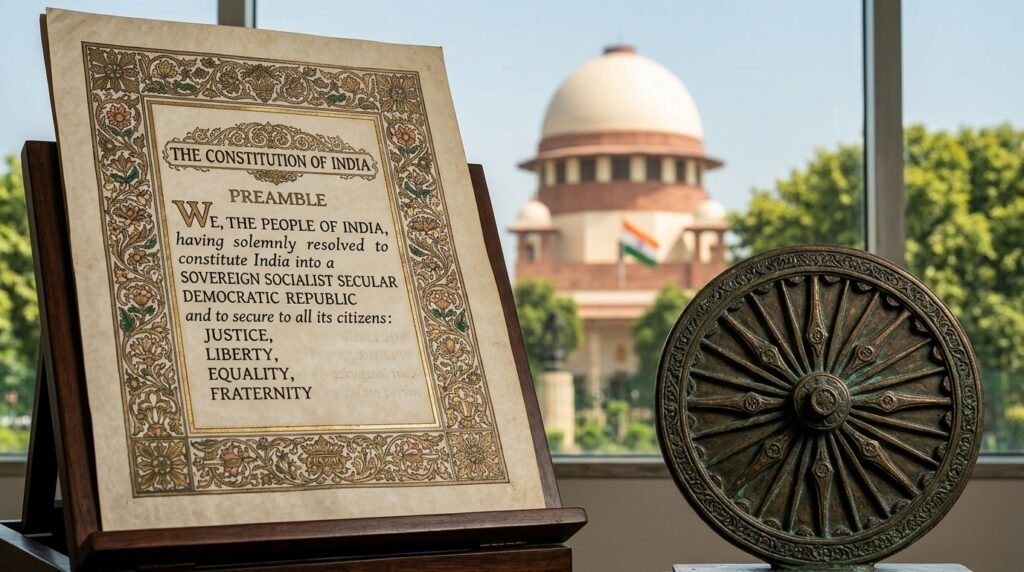
Most laws begin with a short statement of purpose. That’s a preamble. It doesn’t create rights or punish anyone. It simply tells you why the law exists. India’s version does the same job for the entire Constitution, in one flowing sentence of roughly 85 words.
Here’s the preamble in English, as it stands today:
“WE, THE PEOPLE OF INDIA, having solemnly resolved to constitute India into a SOVEREIGN SOCIALIST SECULAR DEMOCRATIC REPUBLIC and to secure to all its citizens: JUSTICE, social, economic and political; LIBERTY of thought, expression, belief, faith and worship; EQUALITY of status and of opportunity; and to promote among them all FRATERNITY assuring the dignity of the individual and the unity and integrity of the Nation; IN OUR CONSTITUENT ASSEMBLY this twenty-sixth day of November, 1949, do HEREBY ADOPT, ENACT AND GIVE TO OURSELVES THIS CONSTITUTION.”
If you’re searching in Hindi, the word you want is prastavana (प्रस्तावना). The meaning stays the same. Think of it like a company’s mission statement. It doesn’t run the daily operations, but it explains what everything else is meant to achieve.
Table of Contents
- Background of the Preamble
- Why the Preamble is so important
- Where the Preamble was borrowed from
- Components of the Preamble
- Key words explained
- Is the Preamble part of the Constitution?
- Landmark Supreme Court cases
- Quick facts and MCQs for exams
- FAQs
Background of the Preamble
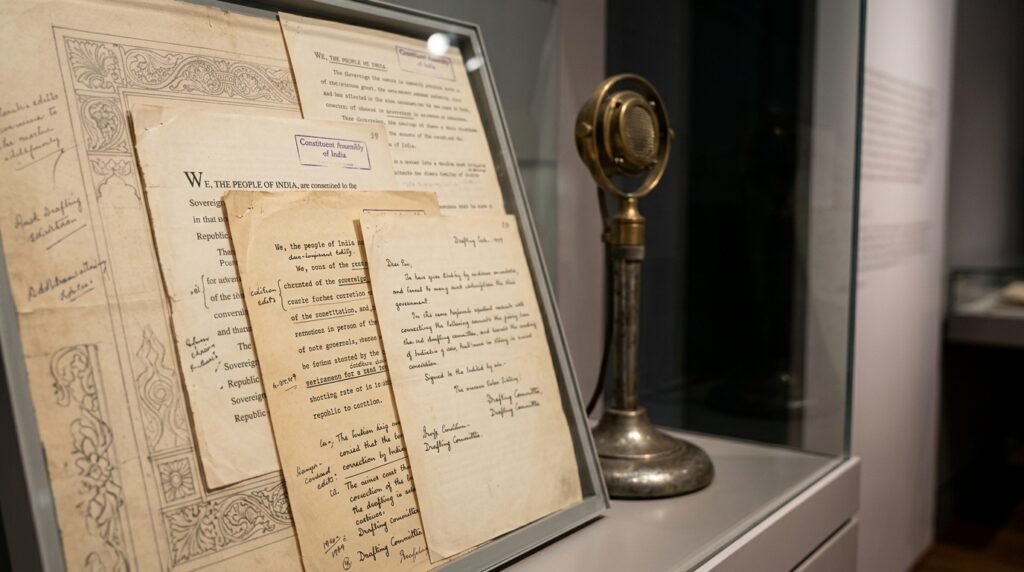
The story starts before the Constitution itself. In December 1946, Jawaharlal Nehru moved the Objectives Resolution in the Constituent Assembly. It laid out the dream: an independent India built on justice, freedom, and equality. The Assembly adopted it on 22 January 1947, and it became the seed of the Preamble.
Then came the heavy lifting. The Drafting Committee, chaired by Dr. B.R. Ambedkar, spent years shaping the full text. Interestingly, the Assembly took up the Preamble last, on 17 October 1949. That made sense. You can’t summarize a document properly until it’s finished. The Constitution itself was adopted on 26 November 1949, and that’s the date written into the Preamble.
Why the Preamble Is So Important

The Preamble isn’t a ceremonial decoration. It does real work, even though it can’t be enforced in court like a Fundamental Right.
- It names the source of power. The Constitution comes from “We, the people of India,” not from a king, a colonial ruler, or Parliament.
- It states the goals. Justice, liberty, equality, and fraternity are the targets every law should aim for.
- It guides interpretation. When a provision is vague, judges read it in light of these ideals.
- It describes the kind of country India is. The five key words tell you its character at a glance.
Here’s a simple example. Suppose a law’s wording could be read two ways. A court will often pick the reading that fits the Preamble’s promise of fairness and dignity.
Where the Preamble Was Borrowed From
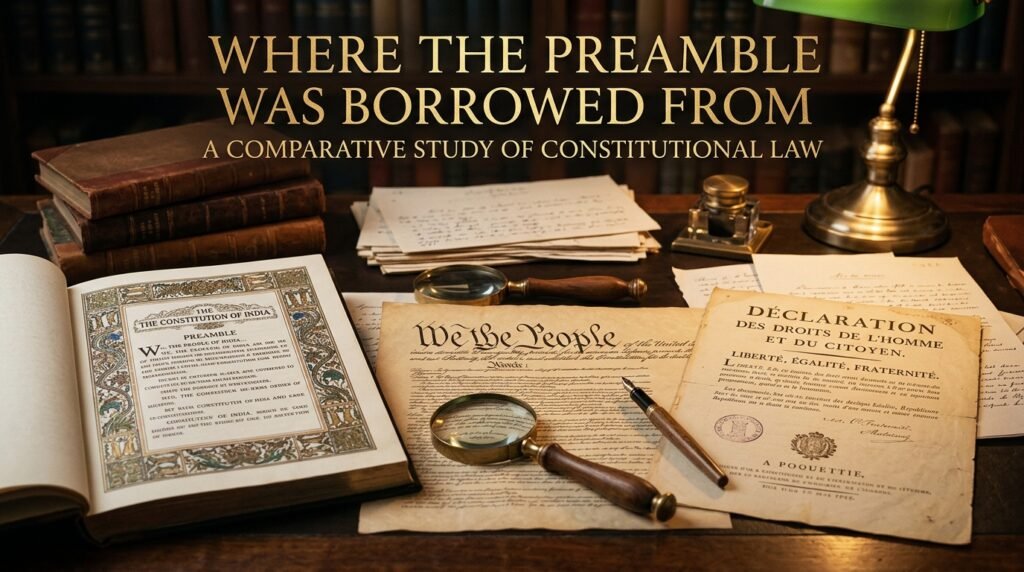
India didn’t copy-paste its Preamble. It drew inspiration from several places and blended them with its own freedom struggle.
- United States: The very idea of opening a constitution with a preamble, and the “We the People” opening, come from the American model.
- French Revolution: Liberty, equality, and fraternity trace back to France.
- Russian Revolution: The ideal of social and economic justice echoes it.
- Irish Constitution: Its own preamble speaks of the dignity and freedom of the individual. Ireland also shaped India’s Directive Principles.
Still, the heart of it is homegrown. Years of struggle against colonial rule gave these words their weight.
Components of the Preamble
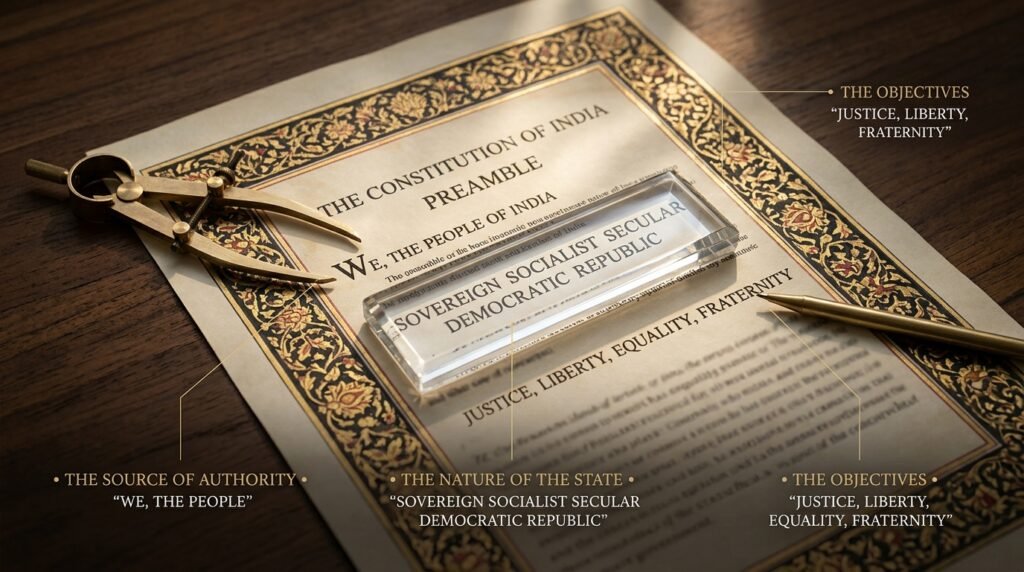
Read the Preamble slowly and you’ll notice it has five moving parts. It names India’s political system, then promises justice, liberty, equality, and fraternity. Each part links to specific provisions you can find in the Constitution. Let’s go through them one by one.
1. It Defines India’s Political System
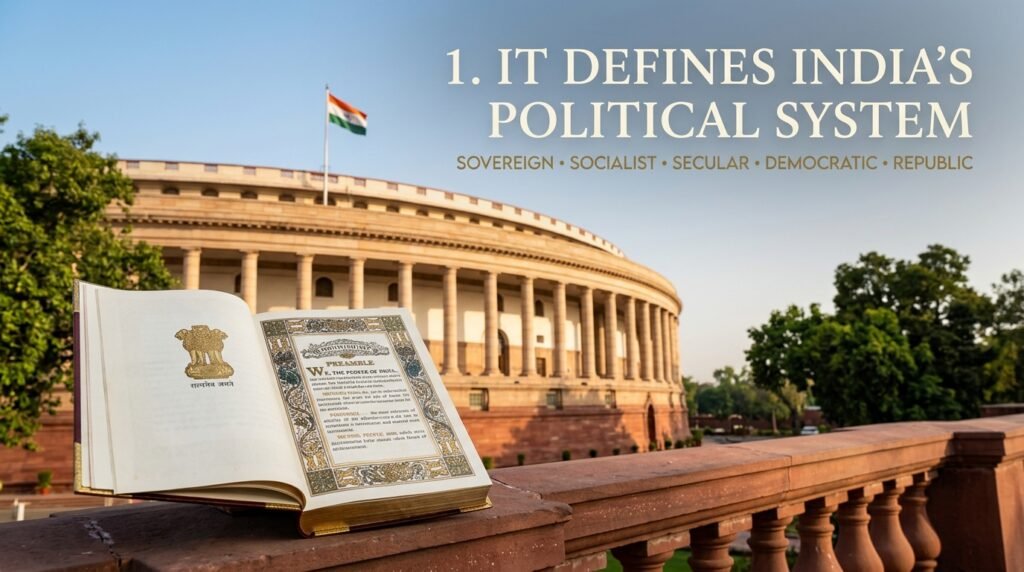
The opening words matter most: “We, the people of India.” They tell you that the Constitution’s authority flows from citizens. Nobody handed it down. The people gave it to themselves. That’s also why the Constitution, not Parliament or the judiciary, sits at the top in India.
Then comes the label for the system itself: a sovereign, socialist, secular, democratic republic. We’ll unpack each of those five words in a moment.
2. It Sets the Kind of Justice India Aims For
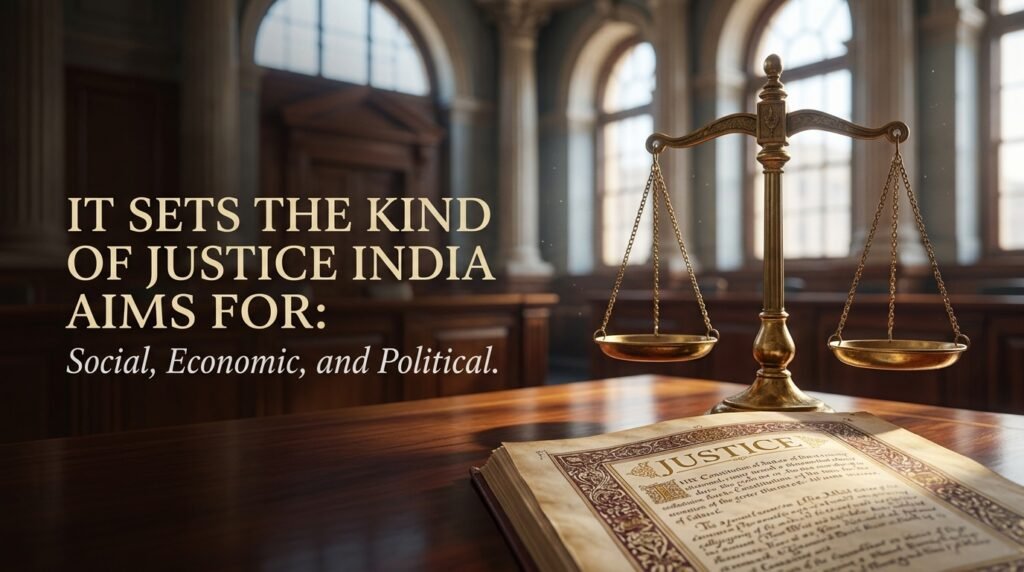
The Preamble promises “justice, social, economic and political.” These aren’t the same thing, so here’s how they differ:
- Social justice means no one gets pushed down because of birth or background. Article 15, which bars discrimination and allows special provisions for disadvantaged groups, is one tool for this.
- Economic justice means poverty shouldn’t lock people out of opportunity. The 103rd Constitutional Amendment, which introduced reservation for economically weaker sections, is one example.
- Political justice means every adult citizen gets a say. Voting in Lok Sabha and State Assembly elections is the everyday proof.
3. It Spells Out the Liberty Citizens Enjoy
The Preamble lists five liberties: thought, expression, belief, faith, and worship. Put simply, you can think what you like, say it, hold your own convictions, follow a faith, and worship in your own way. Article 19 protects freedom of speech and expression, and Articles 25 to 28 cover religious freedom.
However, liberty here isn’t a free-for-all. The Constitution allows reasonable restrictions, such as protecting public order. Your freedom ends where it harms someone else’s.
4. It Promises Equality of Status and Opportunity
This part covers two things. Equality of status means the law treats everyone the same, whether you’re a farmer or a minister. Equality of opportunity means everyone gets a fair shot at education, jobs, and public life.
Articles 14 to 18 carry this promise forward. Think of a government job advertisement open to every qualified citizen. Nobody gets blocked because of religion, caste, or gender. That’s this principle at work.
5. It Builds Fraternity, Dignity, and National Unity
Fraternity simply means a shared sense of brotherhood and belonging. The Preamble ties it to two goals: the dignity of every individual and the unity and integrity of the Nation. Dr. Ambedkar stressed that without fraternity, liberty and equality would stay shallow.
You can see this value in the Fundamental Duties under Article 51A, which ask citizens to respect the Constitution and protect the nation’s unity. The word “integrity” was added in 1976, which we’ll cover shortly.
Key Words in the Preamble Explained: Sovereign, Socialist, Secular, Democratic, Republic
These five words describe India’s identity. Here’s what each one means in plain terms:
- Sovereign: India makes its own decisions. No outside power controls its laws or policies.
- Socialist: The state works to reduce inequality and promote welfare. It doesn’t mean the government owns everything.
- Secular: The state has no official religion and treats all faiths equally.
- Democratic: Power rests with the people, who choose representatives through elections.
- Republic: The head of state is elected, not born into the role. India’s President is elected indirectly for a five-year term.
What Do “Socialist” and “Secular” Mean, and When Were They Added?
Here’s a fact that trips up many students. These two words weren’t in the original 1949 text. The 42nd Constitutional Amendment Act of 1976 added them, along with the word “integrity.” Before that, the Preamble called India a “sovereign democratic republic.”
So why add them? The government of the time wanted to state India’s welfare-oriented and religion-neutral character openly. Supporters said the ideas were already present in the Constitution’s spirit. Critics questioned the timing, since it happened during the Emergency. In November 2024, the Supreme Court dismissed petitions challenging the insertion, so the words remain.
Is the Preamble Part of the Indian Constitution?
Yes, it is. But the Supreme Court didn’t always say so. In the Berubari Union case of 1960, the Court held that the Preamble wasn’t part of the Constitution. It called the Preamble a key to the framers’ minds, but not a source of power or a limit on Parliament.
That view changed in the Kesavananda Bharati case of 1973. The Court declared the Preamble an integral part of the Constitution. In practice, this means it carries real weight when judges interpret the document. Even so, you can’t go to court and demand enforcement of the Preamble on its own.
Can the Preamble Be Amended?
It can, but only within limits. Since the Preamble is part of the Constitution, Parliament can amend it under Article 368. It has happened exactly once, through the 42nd Amendment in 1976.
However, the Kesavananda ruling added a catch. Parliament can’t touch the “basic structure” of the Constitution. Core features like sovereignty, democracy, and the republican form of government fall under this protection. So you could tweak the wording, but you couldn’t strip away the foundations.
Landmark Supreme Court Cases on the Preamble
A handful of cases shaped how courts treat the Preamble today. Here are the ones you’ll see again and again:
- Berubari Union case (1960): The Preamble isn’t part of the Constitution, though it helps explain the framers’ intent.
- Kesavananda Bharati v. State of Kerala (1973): The Preamble is part of the Constitution, and the basic structure doctrine was born.
- S.R. Bommai v. Union of India (1994): Secularism is a basic feature of the Constitution.
- LIC of India v. Consumer Education and Research Centre (1995): The Preamble was again recognized as an integral part of the Constitution.
Berubari Union vs. Kesavananda Bharati: How the Court’s View Changed
The shift between these two cases is one of the biggest turns in Indian constitutional law. In 1960, the Court treated the Preamble as helpful background reading. By 1973, a 13-judge bench placed it inside the Constitution itself.
Why does this matter beyond exams? Because it made the Preamble’s values a yardstick. If a law or amendment attacks the core ideals listed there, courts can strike it down under the basic structure doctrine. That’s a lot of power for a short paragraph.
Preamble Quick Facts for UPSC and Other Competitive Exams
Short on time? Keep this checklist handy:
- The Preamble begins with “We, the people of India.”
- Nehru’s Objectives Resolution inspired it.
- The date of adoption mentioned in it is 26 November 1949.
- The Constitution came into force on 26 January 1950, now celebrated as Republic Day.
- The 42nd Amendment (1976) added “Socialist,” “Secular,” and “Integrity.”
- It has been amended only once.
- It isn’t enforceable in court, but it guides interpretation.
- The Berubari case said it wasn’t part of the Constitution. Kesavananda Bharati said it is.
Common Preamble MCQs and How to Answer Them
Examiners love testing amendments, cases, and sources. A good trick is to match each fact with one anchor word. “Socialist” goes with the 42nd Amendment, “basic structure” with Kesavananda, and “Preamble idea” with the USA. If you’re stuck, eliminate options that mix up these anchors.
Try these three:
- Which amendment added “Socialist” to the Preamble? The 42nd Amendment, 1976.
- Which case declared the Preamble part of the Constitution? Kesavananda Bharati v. State of Kerala, 1973.
- From which country’s constitution was the idea of a Preamble taken? The United States.
FAQs
What is the preamble of Indian Constitution?
The preamble is an introduction to the Constitution. It states India’s goals, core values, and where its authority comes from.
Who wrote the preamble of the Indian Constitution?
Jawaharlal Nehru’s Objectives Resolution shaped it. Dr. B.R. Ambedkar’s Drafting Committee refined the wording, and the Constituent Assembly adopted it.
Is the preamble legally enforceable in court?
No. Courts can’t enforce it directly, but they use it to interpret unclear provisions and understand the Constitution’s underlying intent.
Which words were added to the preamble, and when?
The 42nd Constitutional Amendment Act, 1976 added “Socialist,” “Secular,” and “Integrity” to the preamble. It passed during the Emergency period.
What date does the preamble carry?
It carries 26 November 1949, when the Constituent Assembly adopted the Constitution. Enforcement began on 26 January 1950, Republic Day.
Where was the preamble of the Indian Constitution borrowed from?
The idea comes from the US Constitution. Justice echoes the Russian Revolution; liberty, equality, and fraternity echo the French one.
Why is the preamble called the soul of the Constitution?
Thakur Das Bhargava called it the Constitution’s soul because it captures India’s core ideals and purpose in a few lines.
Conclusion:
So, what is the preamble of Indian Constitution? It’s the short opening statement that sums up everything the country stands for. You’ve seen how it names the people as the source of power. You’ve also seen the goals it sets: justice, liberty, equality, and fraternity.
The preamble of Indian Constitution meaning is easy to hold onto now. It’s a promise, written in plain and powerful words. Read the preamble in English once more, slowly. Each phrase will make more sense than it did before. For example, “sovereign” and “secular” now carry real weight.
The significance of preamble goes well beyond exams. Courts use it to read unclear laws. Citizens can use it to remember what the nation hoped to become. However, its best role is simple. It reminds you that the Constitution belongs to all of us.
what is the preamble of indian constitution what is the preamble of indian constitution what is the preamble of indian constitution what is the preamble of indian constitution what is the preamble of indian constitution what is the preamble of indian constitution what is the preamble of indian constitution what is the preamble of indian constitution what is the preamble of indian constitution what is the preamble of indian constitution what is the preamble of indian constitution what is the preamble of indian constitution what is the preamble of indian constitution what is the preamble of indian constitution what is the preamble of indian constitution what is the preamble of indian constitution what is the preamble of indian constitution what is the preamble of indian constitution what is the preamble of indian constitution what is the preamble of indian constitution what is the preamble of indian constitution what is the preamble of indian constitution
2 thoughts on “What is the Preamble of Indian Constitution: Meaning, Key Words & Why It Matters”