
18 wheeler accident attorney nashville: An 18-wheeler accident in Nashville can leave people dealing with serious injuries, medical expenses, missed work, and uncertainty about what to do next. Understanding the steps to take after a crash can help protect your health, preserve important information, and clarify your legal options.
Truck accident claims can involve more than the driver of the truck. Depending on the circumstances, a trucking company, maintenance provider, cargo-loading company, or vehicle manufacturer may also be involved. Federal trucking regulations and Tennessee personal injury law may affect how a claim is investigated and evaluated.
This guide explains what to do after an 18-wheeler accident in Nashville, how responsibility may be established, what deadlines may apply, and where to find reliable legal information.
Legal Guide 360 provides general educational information. It is not a law firm and does not provide legal representation or individualized legal advice.
Hurt on a job site? Chicago construction site accident attorneys explain your rights, your options, and how to get paid what you deserve.
What to Do Immediately After an 18-Wheeler Accident in Nashville

The actions taken immediately after a truck collision can help protect your safety and preserve information about what happened. Your health comes first, and you should never put yourself at risk to collect evidence.
Consider the following steps when it is safe to do so.
- Move to safety. If possible, move away from traffic and other immediate hazards. Call 911 if anyone is injured, the scene is dangerous, or emergency assistance is needed.
- Seek medical attention. Get an appropriate medical assessment, even if your injuries initially seem minor. Some injuries may not be immediately apparent.
- Report the crash. Follow the instructions of responding law enforcement officers and provide accurate information about what happened.
- Record available details. If it is safe, photograph vehicle damage, the surrounding roadway, traffic signs, visible injuries, and the truck’s identifying information.
- Collect relevant contact information. Obtain the names and contact details of involved drivers and witnesses when possible.
- Keep relevant records. Save medical bills, repair estimates, receipts, insurance correspondence, and documents showing missed work.
- Be careful with statements. Give accurate information, but avoid guessing about the cause of the collision or the extent of injuries. Do not sign documents you do not understand.
- Consider obtaining legal advice. If the collision caused significant injuries, disputed liability, or complicated insurance issues, a qualified Tennessee attorney can explain your options.
You do not need to investigate the crash yourself. Never approach a damaged truck, enter an unsafe roadway, or attempt to retrieve evidence from a commercial vehicle.
Who May Be Liable for a Nashville Truck Accident?18 wheeler accident attorney nashville

Responsibility depends on the facts of the collision. More than one person or business may have contributed to the incident, and each potential defendant’s role must be evaluated using the available evidence.
The truck driver
A driver may be responsible when careless conduct contributes to a crash. Examples may include speeding, unsafe lane changes, distracted driving, following too closely, or failing to respond appropriately to traffic conditions.
Fatigue or impairment may also be relevant when supported by evidence.
The trucking company
A trucking company may face liability if its own negligence contributed to the collision. Potential issues include inadequate driver screening, improper training, unsafe maintenance practices, or company practices that contribute to regulatory violations.
A company may also be legally responsible for certain acts of an employee acting within the scope of employment. Whether that rule applies depends on the employment relationship and the circumstances of the crash.
Maintenance providers and repair businesses
Commercial trucks require regular inspection and maintenance. If defective repairs, missed maintenance, or improper work contributed to a mechanical failure, a maintenance provider or another responsible party may need to be investigated.
Cargo loaders and freight companies
Improperly secured or distributed cargo can affect a truck’s stability, braking, and handling. A loading company or another party responsible for the freight may be relevant when cargo-related problems contributed to the crash.
Truck and component manufacturers
A defective tire, braking component, or other vehicle part may contribute to an accident. Product liability questions require a separate examination of the component, the alleged defect, and the applicable law.
Not every party listed above is liable in every case. Identifying potentially responsible parties requires evidence rather than assumptions.
What Evidence Can Help Establish Fault?
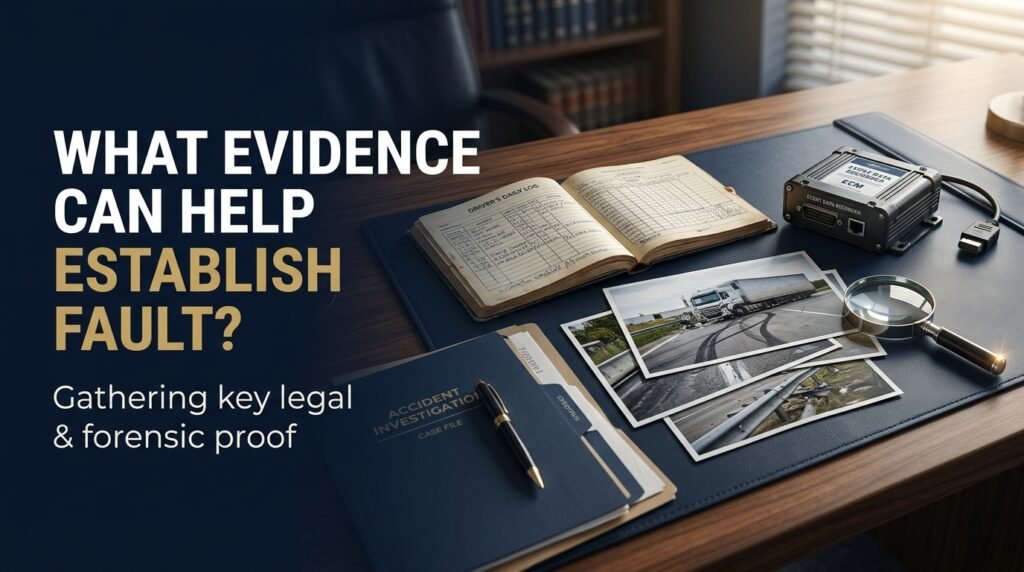
Truck accident investigations can involve several sources of information. The relevant evidence depends on how the crash happened and which issues are disputed.
Common sources include:
- Police crash reports: These may document the scene, involved parties, observations, and preliminary findings.
- Photographs and video: Images from the scene, nearby cameras, or available vehicle cameras may help establish vehicle positions and road conditions.
- Electronic vehicle data: Some commercial vehicles contain systems that record information about vehicle operation or crash events. The available data depends on the equipment installed.
- Driver records: Relevant records may help establish driving time, rest periods, qualifications, or compliance with applicable rules.
- Inspection and maintenance documents: These may help determine whether a mechanical problem or maintenance issue contributed to the crash.
- Witness accounts: Statements from people who observed the collision may help clarify how it occurred.
- Medical records: These help document injuries, treatment, and the connection between the collision and the claimed harm.
- Cargo documentation: Loading records and related documents may be important when shifting or improperly secured freight is suspected.
Some evidence may be lost, overwritten, or become more difficult to obtain over time. When serious injuries or complex liability issues are involved, a qualified attorney may be able to advise on appropriate evidence-preservation steps.
For information about obtaining a Tennessee crash report, visit the Tennessee Department of Safety and Homeland Security’s crash-report guidance.
Tennessee’s Fault Rules and Truck Accident Claims

Tennessee applies a modified comparative-fault system. Under this approach, an injured person’s share of responsibility can affect whether and how much compensation they may recover.
In general, an injured person may recover damages only when their share of fault is less than the combined fault assigned to the defendant or defendants and other persons whose fault may legally be considered. Any recoverable damages are reduced according to the injured person’s share of fault. The application of this rule depends on the facts and applicable law.
For illustration, if the legally recoverable damages are $100,000 and the injured person’s share of fault is determined to be 20%, a proportional reduction would leave $80,000 in damages, assuming the comparative-fault rule applies as described and no other issue changes the calculation.
If the injured person’s negligence is equal to or greater than the relevant opposing fault under Tennessee’s rule, recovery may be barred. Actual outcomes depend on the facts, the parties involved, and the applicable legal principles.
For the underlying legal framework, see the Tennessee Supreme Court’s decision in McIntyre v. Balentine.
Fault should not be assumed simply because an insurer or another driver says you contributed to the crash. The available evidence and applicable law matter.
What Deadlines May Apply to a Tennessee Truck Accident Lawsuit?
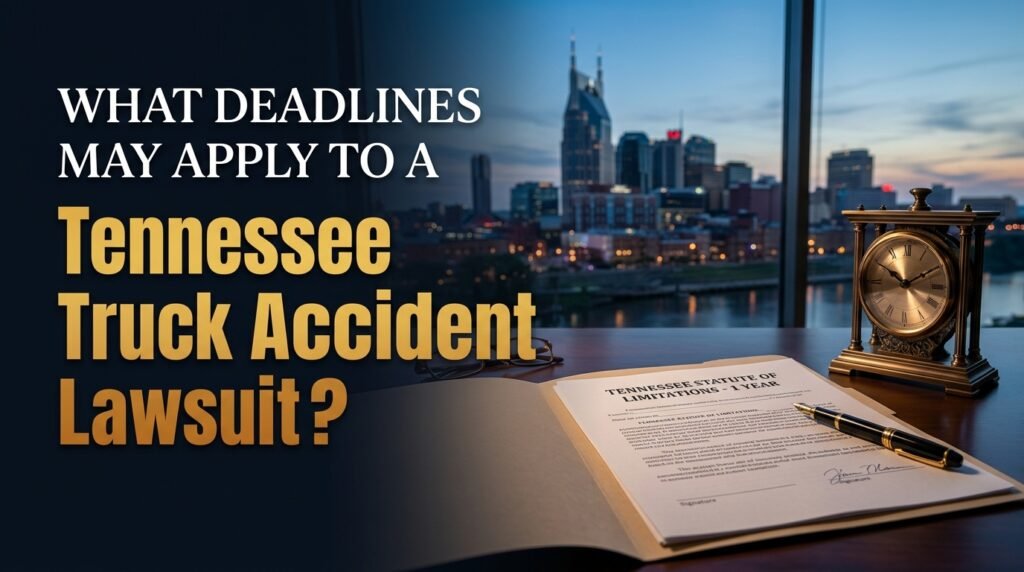
Tennessee generally requires personal-injury actions to be filed within one year after the claim accrues under Tennessee Code Annotated § 28-3-104. This can make the filing deadline an important issue after a truck collision.
The date of the collision is not necessarily sufficient by itself to determine every claim’s deadline. Statutory exceptions and other legal rules may affect when the limitations period begins or ends. Claims involving government entities, for example, can raise additional requirements.
Do not assume that negotiations with an insurer, ongoing medical treatment, or an unanswered insurance claim automatically extend a legal deadline.
Anyone considering a claim should promptly consult a qualified Tennessee attorney about the deadline that applies to their particular circumstances. Missing an applicable deadline can jeopardize the ability to pursue compensation.
This section is general information, not a determination of any individual’s filing deadline.
What Compensation May Be Available After a Truck Accident?
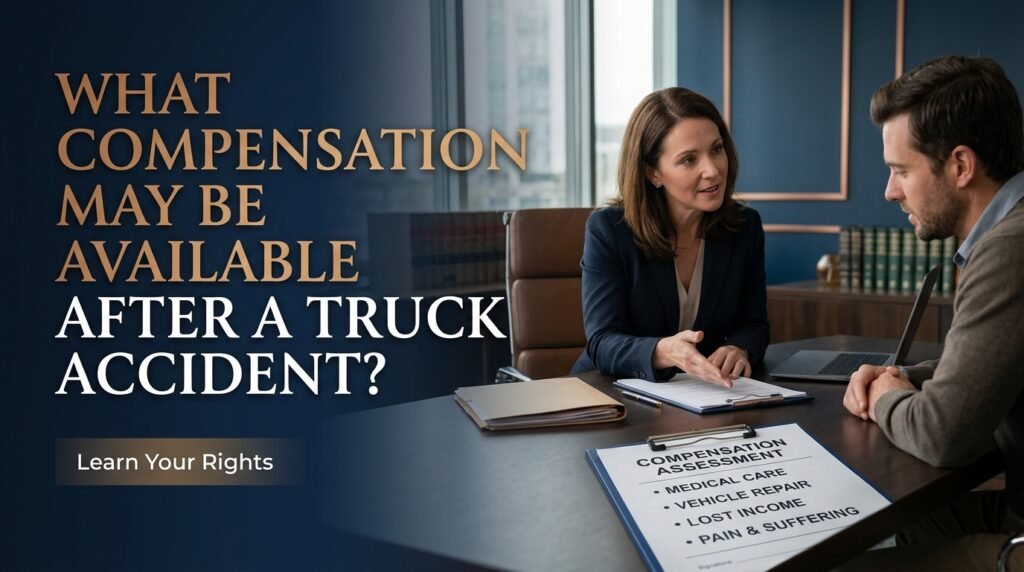
Depending on the facts and applicable law, an injured person may be able to seek compensation for certain losses caused by a truck accident.
Potential categories include:
- Medical expenses: Reasonable and recoverable costs associated with emergency treatment, hospitalization, medication, rehabilitation, and other care.
- Lost income: Earnings lost because injuries prevent someone from working.
- Reduced future earning capacity: Financial losses associated with an injury that affects the ability to earn income in the future.
- Pain and suffering: Compensation that may be available for physical pain and other legally recognized non-economic harm.
- Property damage: Eligible costs of repairing or replacing a damaged vehicle and other covered property.
- Other legally recognized losses: Depending on the circumstances, additional damages may be available under Tennessee law.
Wrongful-death claims may also be possible when a truck collision causes a death. Tennessee Code § 20-5-106 addresses succession to a cause of action when an injury results in death, while § 20-5-113 addresses damages recoverable in a wrongful-death action. Other provisions may also be relevant to who can prosecute a claim.
Punitive damages are not available in every serious accident. They generally require a separate legal basis and are subject to specific standards.
No category of compensation is automatic. Liability, evidence, the nature of the injuries, applicable law, and other circumstances affect whether damages can be recovered.
How Truck Accident Claims Differ From Ordinary Car Accident Claims

Truck collisions can raise issues that do not arise in many ordinary passenger-vehicle accidents.
Federal trucking regulations
Certain commercial motor vehicles and drivers must comply with federal requirements covering subjects such as driver qualifications, hours of service, inspections, and vehicle maintenance.
The Federal Motor Carrier Safety Administration provides a summary of hours-of-service regulations, including information about driving limits, rest requirements, and exceptions.
Not every commercial vehicle or operation is subject to every federal rule. Applicability depends on factors such as the vehicle, the type of operation, and relevant exceptions. An alleged regulatory violation must also be evaluated in the context of the particular accident and applicable law.
Multiple potentially responsible parties
A truck accident may involve the driver, a carrier, a maintenance provider, a cargo handler, or a manufacturer. Determining which parties may be legally responsible can require more extensive investigation than a straightforward two-vehicle collision.
Commercial insurance and records
Commercial trucking operations may involve insurance policies, driver records, inspection documents, and electronic data that are not typically available in the same form after an ordinary car accident.
The existence of commercial insurance does not guarantee payment or establish the value of a claim. Coverage, liability, exclusions, and damages must be evaluated individually.
Common Causes of 18-Wheeler Accidents
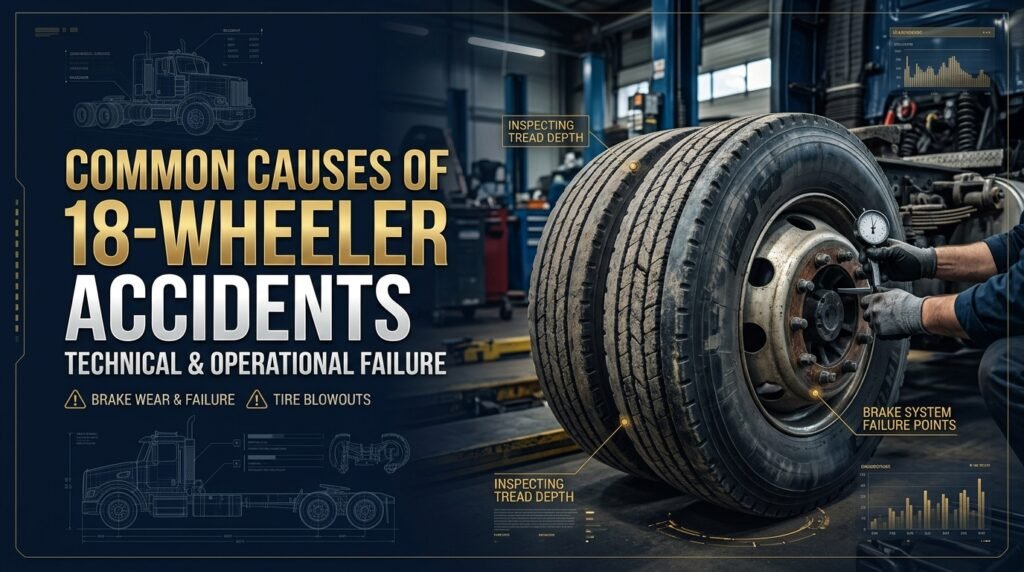
Several conditions and behaviors may contribute to collisions involving large trucks. Identifying the actual cause requires looking at the specific event rather than assuming that a particular factor was responsible.
Common possibilities include:
- Driver distraction or inattention.
- Speed inappropriate for traffic, weather, or road conditions.
- Driver fatigue or failure to comply with applicable rest requirements.
- Unsafe lane changes, turning movements, or following distances.
- Mechanical problems involving brakes, tires, steering, or other components.
- Cargo that is improperly loaded, secured, or distributed.
- Poor visibility, adverse weather, or hazardous roadway conditions.
- Negligent conduct by another motorist.
These factors may overlap. For example, a mechanical problem and a driver’s failure to respond appropriately may both be relevant to the same collision.
A reliable investigation should distinguish between a possible contributing factor and a cause supported by evidence.
Nashville Highways and Truck Traffic
Nashville is connected to major interstate routes, including I-40, I-24, and I-65. These highways carry a mixture of passenger vehicles and commercial traffic.
A collision near an interchange, merging lane, construction zone, or busy commercial corridor may raise questions about vehicle movements, visibility, road design, traffic control, or other conditions.
However, the fact that a crash occurred on a particular highway does not establish that the location is unusually dangerous or that any party was negligent. Such conclusions require relevant data and evidence.
Readers seeking location-specific crash information can consult the Tennessee Department of Safety’s crash-data resources. Official reports and datasets can help establish what is documented about crashes in a particular area or period.
When researching a specific collision, the exact location, date, direction of travel, roadway conditions, and available crash records may all be relevant.
What If the Truck Driver Was Fatigued, Distracted, or Impaired?
Fatigue, distraction, and impairment can affect a driver’s ability to operate a commercial vehicle safely. Whether one of these factors contributed to a particular crash must be established through evidence.
Depending on the circumstances, relevant information may include driver records, witness statements, available electronic data, inspection documents, and investigative findings.
Federal hours-of-service rules govern driving and rest periods for certain commercial drivers. The details depend on the applicable rules and any relevant exceptions. The FMCSA’s hours-of-service resources explain the general requirements.
A suspected violation does not automatically prove every element of a personal injury claim. Its significance depends on the evidence, the applicable legal standards, and its connection to the collision.
How Electronic Truck Data May Help an Investigation
Some commercial trucks have electronic systems that record information about vehicle operation or certain crash events. Depending on the system, relevant information may include vehicle speed, braking activity, or other operational details.
These systems do not all record the same information, and a truck should not be assumed to contain a particular type of recorder or to preserve every desired detail.
When electronic data may be important, timely preservation can matter. Access, retention periods, and the methods required to retrieve the information depend on the equipment and circumstances.
Other evidence, such as photographs, physical damage, witness statements, and official reports, may also be needed to interpret electronic records accurately.
What Happens if a Loved One Dies in a Nashville Truck Accident?
A fatal truck collision can raise difficult questions about responsibility, financial losses, and the legal rights of surviving family members.
Tennessee law provides for wrongful-death claims in qualifying circumstances. Tennessee Code § 20-5-106 addresses succession to a cause of action when an injury results in death, and § 20-5-113 addresses damages recoverable in a wrongful-death action. Other provisions may also be relevant to who can prosecute a claim.
Potentially relevant losses may include certain expenses and damages recognized by Tennessee law. The availability and calculation of these damages depend on the applicable statutes, the evidence, and the circumstances of the case.
Families facing this situation should obtain guidance from a qualified Tennessee attorney who handles wrongful-death matters. This general guide cannot determine eligibility or predict the outcome of an individual claim.
Where to Find Reliable Tennessee Legal Resources
Readers researching a Nashville truck accident can begin with government and court resources.
- Tennessee personal-injury limitations: Review Tennessee Code Annotated § 28-3-104 for the general statutory framework governing personal-injury deadlines.
- Tennessee comparative fault: Read the Tennessee Supreme Court’s decision in McIntyre v. Balentine.
- Wrongful-death claims: Review Tennessee Code § 20-5-106 and § 20-5-113.
- Federal hours-of-service requirements: Consult the Federal Motor Carrier Safety Administration’s regulatory summary.
- Tennessee crash data: Explore the Tennessee Department of Safety’s crash-data page.
- Crash reports: Review the state’s crash-report guidance.
These resources can help readers understand the general legal framework and locate relevant records. Statutes, agency guidance, and court decisions serve different purposes, so they should be read in context.
Frequently Asked Questions
How soon should I seek medical attention after a truck accident?
Seek emergency care when needed, and obtain medical evaluation for possible injuries as soon as reasonably possible. Do not delay necessary treatment to collect evidence or contact an insurer.
Can more than one party be responsible for an 18-wheeler accident?
Yes. Depending on the evidence, responsibility may involve a driver, trucking company, maintenance provider, cargo handler, manufacturer, or another party. Each party’s potential liability must be evaluated separately.
Does a truck driver’s violation of a federal regulation automatically prove negligence?
Not necessarily. A violation may be relevant evidence, but its legal effect depends on the regulation, the facts, and applicable law. It does not automatically establish liability or the amount of damages.
How long do I have to file a truck accident lawsuit in Tennessee?
Tennessee generally requires personal-injury actions to be filed within one year after the claim accrues, subject to statutory exceptions and other applicable rules. The deadline for a particular claim should be confirmed promptly with a qualified Tennessee attorney.
Can I obtain a copy of a Tennessee crash report?
The Tennessee Department of Safety provides guidance on requesting crash reports. The correct process depends in part on which law enforcement agency investigated the collision. Start with the state’s crash-report information.
How much compensation is a truck accident claim worth?
There is no reliable universal amount. The value of a claim depends on factors such as the injuries, documented losses, available evidence, liability, applicable law, and available insurance coverage. A general online article cannot accurately value an individual case.
Conclusion
An 18-wheeler accident in Nashville can create medical, financial, and legal challenges. Understanding what to do after a collision, how responsibility may be established, and which legal rules may apply can help readers make more informed decisions.
Preserve relevant records when possible, seek appropriate medical care, and use reliable sources when researching Tennessee law. If serious injuries, disputed fault, or a potential lawsuit are involved, consider consulting a qualified Tennessee attorney promptly about your specific circumstances and any applicable deadlines.
Legal Guide 360 aims to provide clear, educational information to help readers understand legal topics and identify reliable resources. This article is general information, not legal advice, and it does not establish an attorney-client relationship.
Sources and Further Reading
- Tennessee Code Annotated § 28-3-104 — Personal-injury limitations
- Tennessee Supreme Court — McIntyre v. Balentine
- FMCSA — Summary of Hours-of-Service Regulations
- Tennessee Department of Safety — Crash Data
- Tennessee Department of Safety — Obtaining a Crash Report
- Tennessee Code § 20-5-106 — Injury Resulting in Death; Succession to Cause of Action
- Tennessee Code § 20-5-113 — Damages Recoverable in Wrongful Death
18 thoughts on “Nashville 18-Wheeler Accidents: Legal Rights and 18 wheeler accident attorney nashville”