
IAS Hierarchy: Designations and Posts from Entry to Top
Ever wondered what an IAS officer actually does once the exam is over? Most of us only see the title and the official car. The career behind it is far more interesting.
An IAS post isn’t a single job. It’s a ladder with many rungs. You begin in a district, then move through state departments and central ministries. Your IAS rank, seniority, and performance decide how fast you climb. At the very top sits the UPSC highest post, and only a handful of officers ever get there.
This guide walks you through the full IAS hierarchy, rung by rung.
What is the preamble of Indian Constitution? A plain-English guide to its meaning, key words, and the one amendment that changed it.
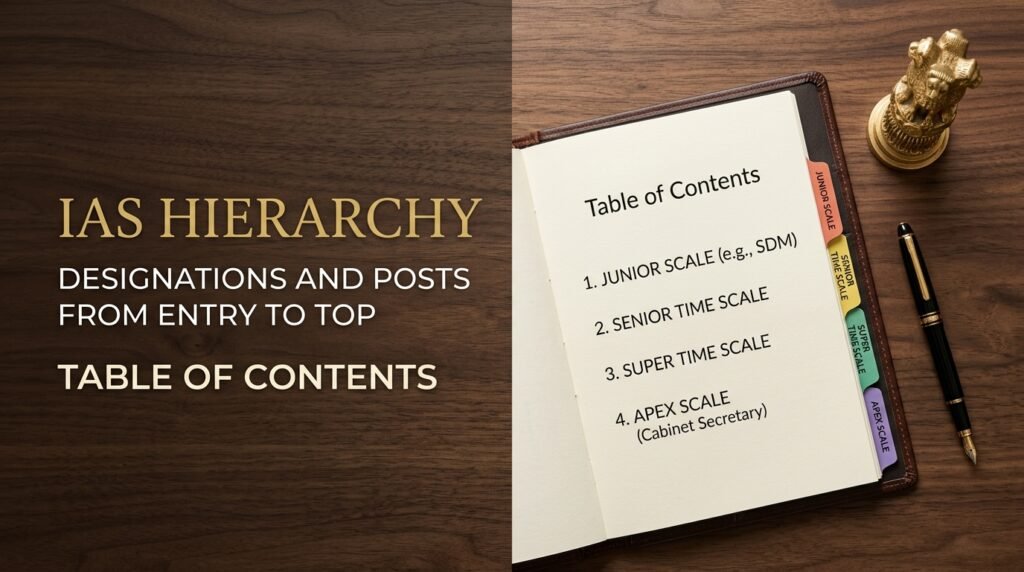
Table of Contents
- What the Indian Administrative Service is
- How recruitment works
- IAS designations in order
- Salary and pay levels
- IAS vs IPS vs IFS
- Promotions and career timeline
- Conclusion and FAQs
What Is the Indian Administrative Service (IAS)?

The Indian Administrative Service is the civil service that runs the country’s day-to-day administration. It’s one of the All India Services, which means its officers can serve both state governments and the Centre. Think of IAS officers as the people who turn laws and policies into real action on the ground.
An officer might manage a district’s revenue and law and order, then later draft policy in a state secretariat. Years on, the same person could help run a central ministry. That’s the permanent bureaucracy at work: governments change, but the machinery keeps moving.
How the IAS Recruitment Process Works
There are three ways to become an IAS officer. The main route is the Civil Services Examination, which UPSC conducts every year. It has three stages:
- Prelims: two objective papers, General Studies and CSAT (the aptitude paper).
- Mains: nine descriptive papers. Two language papers only qualify, so seven count toward your score.
- Interview: the personality test, which finishes the selection.
The other two routes are less known. State Civil Service officers can be promoted into the IAS on merit. Also, outstanding non-State Civil Service officers can be selected under special regulations, usually when they hold a gazetted post and have enough years of service behind them.
Once selected, you’re allotted a state cadre. Then comes training at LBSNAA in Mussoorie, where you start life as a probationary officer.
IAS Officer Designations at Every Level
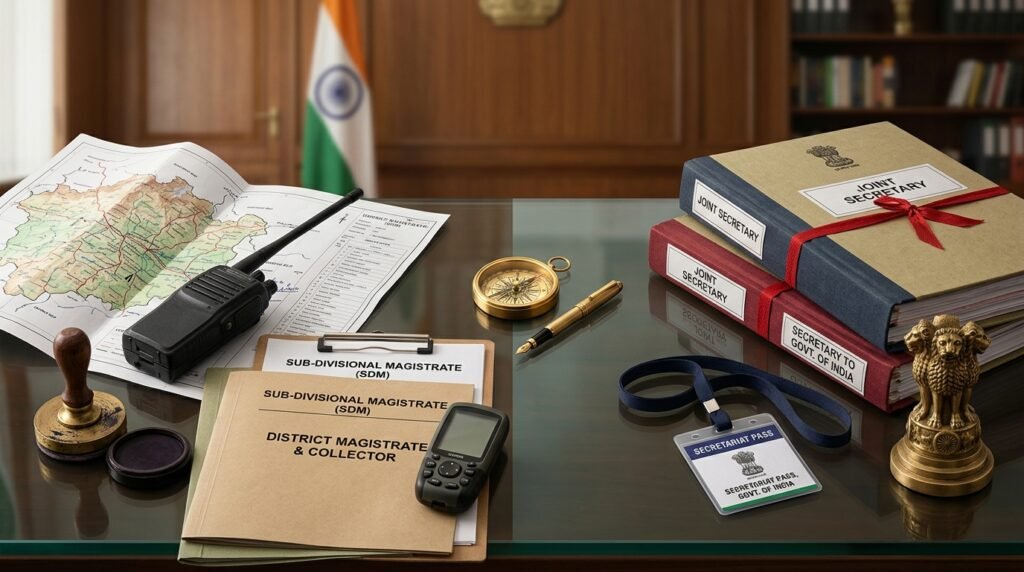
Here’s the thing about IAS posts: nobody holds one title forever. Officers rotate through many roles as they grow. This table shows the usual pattern, grade by grade.
| Grade | Typical Posts |
| Junior Time Scale | Sub-Divisional Magistrate (SDM); Under Secretary or Assistant Director in the early years |
| Senior Time Scale | Additional District Magistrate (ADM); Deputy Secretary in a state |
| Junior Administrative Grade | District Magistrate (DM); Joint Secretary in a state; Deputy Secretary at the Centre |
| Selection Grade | DM of a larger district; Special Secretary in a state; Director at the Centre |
| Super Time Scale | Divisional Commissioner; Secretary in a state; Joint Secretary at the Centre |
| Above Super Time Scale | Principal Secretary in a state; Additional Secretary at the Centre |
| Apex Scale | Chief Secretary of a state; Secretary to the Government of India |
| Cabinet Secretary Grade | Cabinet Secretary (a single post) |
The grouping by work area makes this easier to picture:
- District level: SDM, ADM, then DM (also called District Collector or Deputy Commissioner), and finally Divisional Commissioner.
- State secretariat: Under Secretary, Deputy Secretary, Joint Secretary, Principal Secretary, Additional Chief Secretary, and Chief Secretary.
- Central government: Deputy Secretary, Director, Joint Secretary, Additional Secretary, Secretary, and Cabinet Secretary.
Titles shift a little from state to state. So treat the names as close cousins, not exact twins.
IAS Officer Salary and Pay Scale by Rank
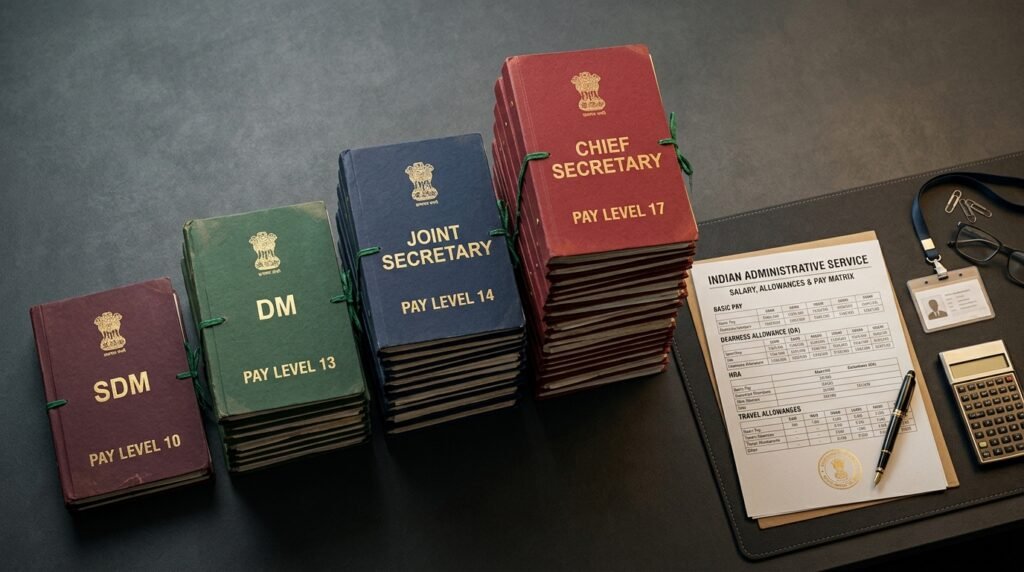
IAS pay follows the pay matrix set under the Seventh Pay Commission. Every grade maps to a pay level, and your basic pay climbs as you move up. On top of that come allowances such as dearness allowance, housing, and transport. So the real take-home is higher than the basic figures below.
For example, a fresh SDM starts at Level 10. A Chief Secretary sits at Level 17. The gap between them is big, but it’s built up slowly over decades.
How Pay Levels Rise from SDM to Cabinet Secretary
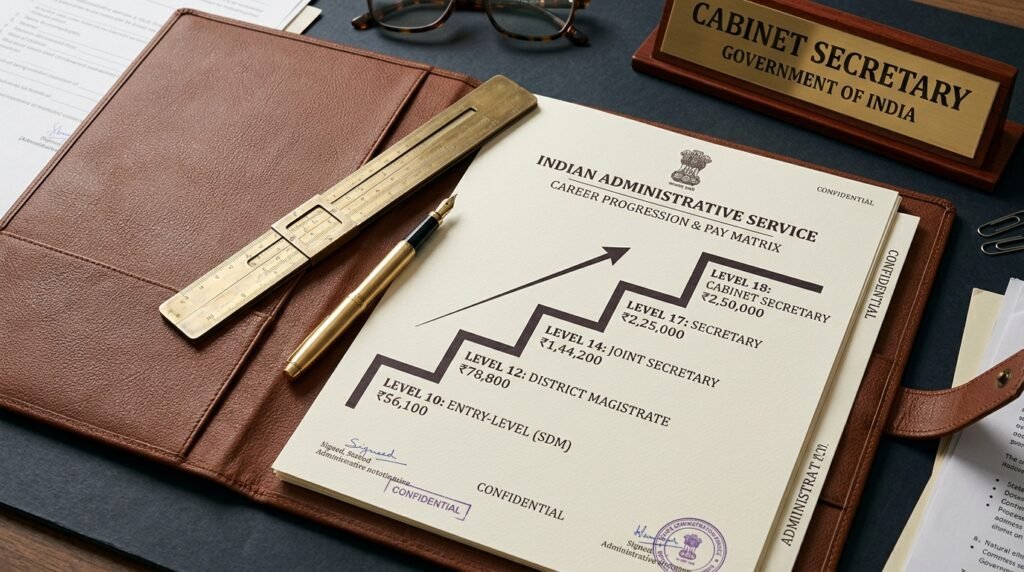
| Pay Level | Approx. Basic Pay (Monthly) | Typical Post |
| 10 | ₹56,100 | SDM / Under Secretary |
| 11 | ₹67,700 | ADM / Deputy Secretary |
| 12 | ₹78,800 | District Magistrate |
| 13 | ₹1,18,500 | DM / Director |
| 13A | ₹1,31,100 | Divisional Commissioner / Joint Secretary |
| 14 | ₹1,44,200 | Secretary-level in a state / Joint Secretary |
| 15 | ₹1,82,200 | Principal Secretary / Additional Secretary |
| 16 | ₹2,05,400 | Additional Chief Secretary |
| 17 | ₹2,25,000 | Chief Secretary / Secretary to GoI |
| 18 | ₹2,50,000 | Cabinet Secretary |
These are basic figures. Always check the latest government notification before quoting exact numbers.
IAS vs IPS vs IFS: How the Hierarchies Compare
All three services come through the same UPSC exam, yet the jobs differ a lot. Here’s the quick version:
- IAS: runs administration, policy, and public service delivery.
- IPS: handles policing, law enforcement, and internal security.
- IFS: represents India abroad through diplomacy and foreign relations.
One small correction is worth making. The Indian Foreign Service is a central service, not an All India Service. The other All India Services are the IAS, the IPS, and the Indian Forest Service. Many articles mix this up.
Which Service Carries More Authority at the District Level?
In a district, the DM leads. That officer coordinates every department, from revenue to health to disaster response. However, the Superintendent of Police, an IPS officer, runs the police force itself. The two work side by side.
So who has “more” authority? In overall coordination, the DM does. In policing matters, the SP does. In big cities with a commissioner system, the Police Commissioner takes charge of the police. IFS officers don’t hold district posts at all, since their work happens at embassies and missions abroad.
IAS Promotion Process and Career Timeline
Promotions in the IAS mostly follow seniority, backed by performance records and vigilance clearance. Early on, moves happen almost automatically as you complete set years of service. Later, the climb gets competitive. For senior central posts like Joint Secretary and above, officers must be empanelled, which means being cleared for central deputation.
That’s why many officers spend time in Delhi. Central deputation adds national-level experience, and it often shapes who reaches the top posts.
How Many Years Does It Take to Become a Chief Secretary?
There’s no fixed number, but 30 years or more is common. A rough path looks like this:
- Years 1–4: training, then SDM.
- Years 5–12: ADM, then DM.
- Years 13–25: Divisional Commissioner, Secretary, or Joint Secretary at the Centre.
- Years 25–35: Principal Secretary, then Additional Chief Secretary or Chief Secretary.
Timelines vary by state and by vacancies. Also, only one officer per state becomes Chief Secretary at a time, so seniority alone doesn’t guarantee it.
Frequently Asked Questions About the IAS
What is the highest IAS post in India?
The Cabinet Secretary is the highest IAS post. This officer heads the civil services and reports to the Prime Minister.
What is the first IAS post after training?
Most officers start as Sub-Divisional Magistrate in a district, handling revenue, law and order, and local administration under close supervision.
What is the lowest IAS post?
Officially, the entry point is the probationary officer at LBSNAA, then Sub-Divisional Magistrate or equivalent field post after training ends.
What is the difference between a District Magistrate and a District Collector?
They’re the same IAS officer. Collector covers revenue duties, while Magistrate covers law-and-order powers. Some states use Deputy Commissioner instead.
How is IAS different from IPS and IFS?
IAS runs administration, IPS handles policing, and IFS manages diplomacy. All three come through the same UPSC Civil Services Examination.
How much does an IAS officer earn at the start?
Entry-level officers sit at Pay Level 10 with a basic pay of ₹56,100 before allowances under the Seventh Pay Commission.
Can state civil service officers become IAS officers?
Yes. State Civil Service officers can be promoted to the IAS on merit, subject to DoPT regulations and UPSC selection.
Conclusion:
Every IAS post is a step toward something bigger. You start small, maybe running a sub-division, and you grow into roles with real weight. It’s a long road. But it’s a meaningful one.
Your IAS rank shapes how that road unfolds. Seniority, performance, and a bit of timing all play a part. Along the way, you move between districts, state offices, and central ministries. Each move adds a new skill. Few careers teach you this much.
Now you’ve seen the full IAS hierarchy, from entry level to the top. Only one officer reaches the UPSC highest post at a time. Still, understanding all the IAS posts helps you plan, prepare, and dream with clear eyes. So keep going. You’ve got this.
ias post ias post ias post ias post ias post ias post ias post ias post
1 thought on “IAS Post Hierarchy in India: Ranks, Designations & Posts Explained (2026)”