
So you’re asking: Are binary triggers legal in Florida? You’re not alone. Gun owners across the state search this question every day, and the answer isn’t as simple as a quick yes or no.
Let’s clear things up. Binary triggers let your rifle fire once when you pull the trigger and once when you release it. That doubles your rate of fire. Florida law hasn’t banned them outright, but the rules can feel murky if you don’t know where to look. Whether you own a Franklin Armory BFSIII or you’re thinking about buying one, you need real answers, not guesswork.
This guide breaks it all down. We’ll cover whether binary triggers are legal in Nevada, whether binary triggers are legal in NC, and whether binary triggers are legal in Texas, since binary-trigger laws vary widely by state. Is a binary trigger legal where you live? Let’s find out together.
Hit by an 18-wheeler in Nashville? An accident attorney who fights trucking companies daily. Free case review, no fee unless you win.
Best California-Legal Tactical Firearms 2026
If you’re shopping for tactical firearms and you live in a restricted state, start here first. California’s rate-of-fire and trigger-activator rules knock binary triggers off the table entirely, so before you build or buy anything, check what’s allowed in your state. We’ve got a full breakdown of California-legal tactical firearms if you want to build smart instead of buying something you can’t keep.
Where Binary Triggers Are Banned or Ambiguous
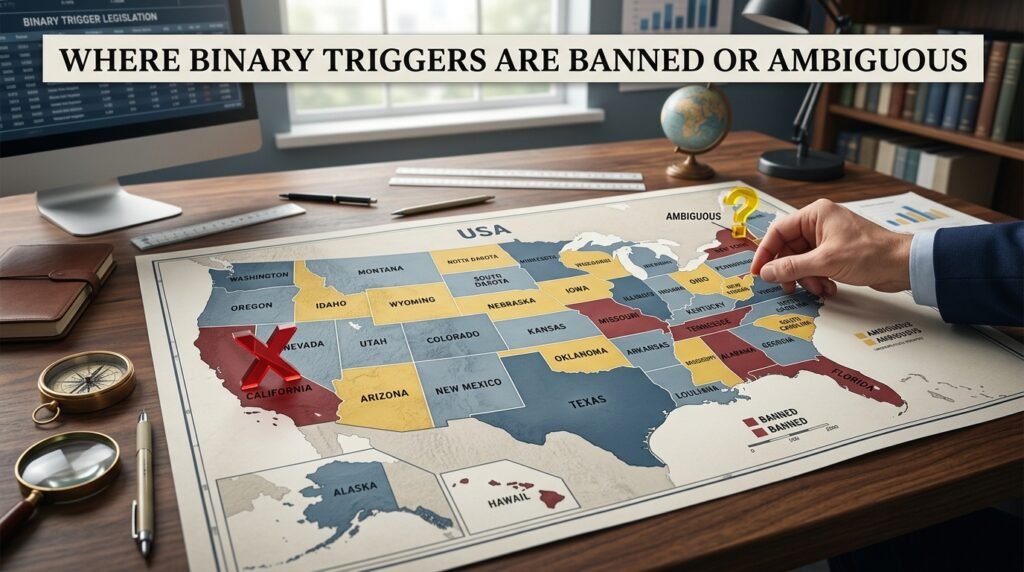
Twelve states ban binary triggers outright, and two more sit in a gray zone that trips people up constantly. Florida and Washington, D.C. don’t have laws that name binary triggers directly. Instead, they rely on broader definitions that might catch them, depending on how a court reads the statute. Nobody’s tested that in Florida yet, which is exactly why so many owners keep typing “are binary triggers legal in Florida” into Google.
Here’s a quick snapshot of where things stand.
| State | Status | Rule | Statute / Case |
| California | Banned | Prohibited as a multiburst trigger activator; possession and sale barred since 2019. | Cal. Penal Code §§ 16930 & 32900 |
| Connecticut | Banned | Prohibited as a rate-of-fire enhancement firing more than one round per trigger operation. | Conn. Gen. Stat. § 53-206g |
| Delaware | Banned | Classed as a rapid-fire device; manufacture, sale, and possession barred. | 11 Del. C. § 1444 |
| Florida | Restricted | Likely covered by the broad bump-fire-stock rate-of-fire definition, but untested against binary triggers. | Fla. Stat. § 790.222 |
| Hawaii | Banned | Expressly prohibits a device that fires on both pull and release of the trigger. | Haw. Rev. Stat. § 134-8.5 |
| Illinois | Banned | Prohibited under PICA’s rate-of-fire increase ban, effective 2023. | 720 ILCS 5/24-1.9 |
| Maryland | Banned | Rapid-fire trigger activator definition names binary trigger systems directly. | Md. Code, Crim. Law § 4-301 & § 4-305.1 |
| Massachusetts | Banned | 2024 law names binary triggers under rapid-fire trigger activator coverage. | Mass. Gen. Laws ch. 140, § 121; ch. 269, § 10(c) |
| New Jersey | Banned | Falls under the machine-gun definition covering mechanisms that don’t require a press for each shot. | N.J. Stat. § 2C:39-1 |
| New York | Banned | Rapid-fire modification device definition expressly includes binary trigger systems. | N.Y. Penal Law § 265.00(26), (29) & § 265.01-c |
| Oregon | Banned | Named directly under the 2025 rapid-fire activator ban. | Or. Rev. Stat. § 166.352 (SB 243) |
| Rhode Island | Banned | Expressly prohibits possession of a binary trigger. | R.I. Gen. Laws § 11-47-8(d) |
| Washington | Banned | Falls under the machine-gun definition covering non-per-shot trigger mechanisms. | RCW 9.41.010; RCW 9.41.190 |
| District of Columbia | Restricted | No statute names binary triggers, but registration rules leave no clear lawful path. | D.C. Code §§ 7-2501.01 & 7-2502.02 |
That’s a lot of legal language, and we get it if your eyes glaze over. The short version: if your state’s on the “Banned” list, don’t buy one. If it says “Restricted,” talk to an attorney before you spend your money.
Litigation Status and Recent Changes
Gun laws don’t sit still. Courts stay them, revive them, or strike them down completely, and that can flip a state’s status overnight. Here’s where each contested case stands as of mid-2026.
California
California’s 2018 amendment expanded its existing statute to reach any aftermarket trigger system that fires more than one round per activation cycle. The state’s DOJ treats binary triggers as flat-out prohibited, and retailers won’t ship them there. This one’s settled, at least for now.
Connecticut
Connecticut’s rate-of-fire enhancement ban covers any device where the trigger pull and reset count as a single operation. Binary triggers fall squarely within that definition, so possession, sale, and manufacture are all off the table.
Delaware
Delaware’s rapid-fire device definition is broad by design. It covers anything that increases the rate of fire beyond what you could manage unassisted, and binary triggers check that box. They’re classed alongside destructive weapons, which makes this a felony-level offense.
Florida
Here’s the section you probably came for: Is a binary trigger legal in Florida? Florida Statute § 790.222 defines a prohibited bump-fire stock in sweeping terms, covering any device used to boost your rate of fire. No Florida court has actually ruled on whether that language reaches binary triggers specifically. That gap matters. Most manufacturers won’t ship binary triggers into Florida because of it, and that alone tells you how the industry reads the risk. If you’re asking whether binary triggers are legal in Florida because you want to buy one, the honest answer is: treat it as legally risky until a court or the legislature settles the question for good.
Hawaii
Hawaii doesn’t leave room for interpretation. Its multiburst trigger activator prohibition names a device that fires on both the pull and the release, which describes a binary trigger word for word.
Illinois
Illinois came at this from a different angle. Its machine-gun definition alone wouldn’t catch a binary trigger, but the state’s broader PICA law bans any device designed to increase a semiautomatic firearm’s rate of fire above standard. That provision does the work, and it took effect in January 2023.
Maryland
Maryland doesn’t make you guess. Its rapid-fire trigger activator definition lists binary trigger systems by name, right alongside bump stocks and hellfire triggers. The Fourth Circuit upheld the ban in Maryland Shall Issue, so this one’s been through the courts and survived.
Massachusetts
Massachusetts banned bump stocks and trigger cranks back in 2018, then closed the binary trigger loophole in October 2024. Chapter 135 of the Acts of 2024 added rapid-fire trigger activator coverage that specifically names binary triggers and hellfire triggers. There’s no licensing workaround here.
New Jersey
New Jersey doesn’t wait around for federal guidance. Its machine-gun definition is broad enough to cover any mechanism that doesn’t require a fresh trigger press for every shot. That release-fired second round is exactly what pulls binary triggers into the ban.
New York
New York wrote binary triggers into the law by name. Penal Law § 265.00(26) defines a rapid-fire modification device, and subsection (29) separately defines a binary trigger system as one that fires once on pull and again on release. Both provisions came from 2019 legislation, and possession is a crime under § 265.01-c.
Oregon
Oregon is the newest state to join the ban list. SB 243, the Community Safety Firearms Act, took effect in September 2025 and defines a binary trigger system in plain language: fires on pull, fires again on release. Possession is a misdemeanor, and manufacture or sale is a felony, with no grandfather clause protecting devices bought before the law changed.
Rhode Island
Rhode Island’s law is short and to the point. Section 11-47-8(d) makes it unlawful to possess a bump-fire device, binary trigger, or trigger crank. Penalties run up to 10 years, so this isn’t a good place to test the waters.
Washington
Does Washington ban binary triggers? Yes, though not by name. The release-fired round places binary triggers inside Washington’s machine-gun definition under RCW 9.41.010. Here’s the twist: Washington does not ban forced-reset triggers, which fire one round per pull instead of one per pull-and-release cycle—the same general category of trigger, but with a completely different legal outcome.
District of Columbia
D.C.’s machine-gun definition was narrowed to automatic-only fire back in 2008, and no local statute names binary triggers specifically. That sounds like good news, but the District’s registration and assault-weapon rules leave almost no lawful path for a binary-capable host firearm anyway. Manufacturers don’t ship there, which says a lot about how the industry reads this one.
Iowa
Iowa keeps its machine-gun definition tied to a single function of the trigger firing more than one shot. A binary trigger fires one round per function, pull and release counted separately, so it doesn’t meet that threshold. Binary triggers are legal in Iowa.
Minnesota
Minnesota’s had a wild ride. The state added a binary-trigger prong to its statute in 2024, but the Minnesota Court of Appeals struck it down and severed it in May 2026 for violating the state’s single-subject clause. That ruling was procedural, not a Second Amendment win, which means the legislature could pass a standalone ban later. For now, though, are binary triggers legal in Minnesota? Yes. Just keep an eye on this one.
Nevada
Are binary triggers legal in Nevada? Yes, and the reasoning is worth understanding. NRS 202.274 bans devices that eliminate the need for a separate movement for each trigger function. A binary trigger still requires you to release the trigger before the second round fires, so it doesn’t meet that bar. Here’s the twist: Nevada also bans forced-reset triggers under that same statute. Same neighborhood, different rules.
Vermont
Vermont’s law only reaches bump-fire stocks, which use recoil energy to bounce the trigger against your finger repeatedly. Binary triggers use a completely different mechanism, so Vermont’s statute doesn’t cover them.
Virginia
Virginia’s trigger activator definition covers devices that let you fire more than one shot per pull by harnessing recoil energy, which is a bump-stock mechanic, not a binary one. A 2024 amendment added auto sears to the list but still left binary triggers untouched. Keep an eye on pending forced-reset trigger bills, since those could reshape this section down the road.
Where Binary Triggers Are Legal
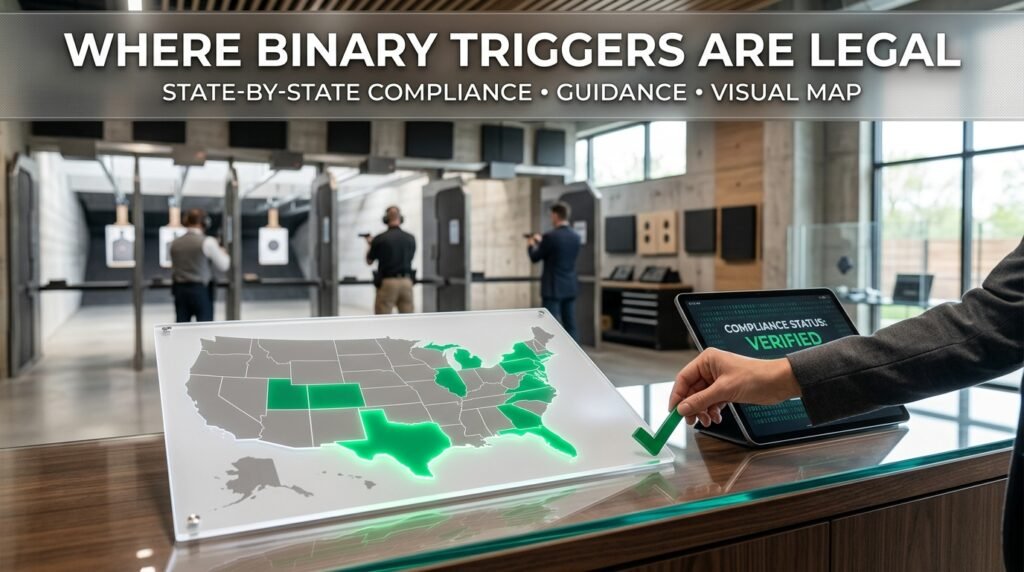
Binary triggers are legal in 37 states, which covers most of the country. Texas, Arizona, Georgia, Ohio, Pennsylvania, Nevada, Vermont, Virginia, and Iowa all fall into this camp, and plenty of Southern and Midwestern states join them.
Here’s the full rundown of binary trigger legal states:
Alabama, Alaska, Arizona, Arkansas, Colorado, Georgia, Idaho, Indiana, Iowa, Kansas, Kentucky, Louisiana, Maine, Michigan, Minnesota, Mississippi, Missouri, Montana, Nebraska, Nevada, New Hampshire, New Mexico, North Carolina, North Dakota, Ohio, Oklahoma, Pennsylvania, South Carolina, South Dakota, Tennessee, Texas, Utah, Vermont, Virginia, West Virginia, Wisconsin, and Wyoming.
If you’re wondering whether binary triggers are legal in NC, North Carolina sits comfortably on this list with no state statute reaching binary trigger mechanisms at all.
How to Verify Binary Trigger Legality in Your State
State gun law moves fast, and a list like this one can go stale the moment a legislature reconvenes. Before you buy, run through a quick checklist:
- Search your state’s penal code for terms like “trigger activator,” “rapid fire device,” or “rate of fire enhancement.”
- Check whether your state defines machine guns by “single function of the trigger” (usually binary-friendly) or by output over time (often binary-hostile).
- Look for pending bills. A state that’s silent today can pass a ban in a single legislative session, as Oregon did in 2025.
- Call a local FFL dealer. They deal with these rules daily and usually know more quickly than a Google search.
Checking Your State’s Attorney General Guidance
Your state Attorney General’s office often publishes plain-language guidance on firearm accessory law, and it’s usually more current than a blog post like this one. Search “[your state] Attorney General firearm accessory guidance” and look for anything mentioning trigger activators, rate-of-fire devices, or binary triggers by name. If your state’s AG hasn’t weighed in, that silence is itself useful information. It usually means the law hasn’t caught up yet, which is exactly the situation Florida finds itself in right now.
Binary Triggers Worth Buying
If you live in a green state, here’s where to spend your money. Franklin Armory’s BFSIII line dominates this space, covering AR platforms, the Stribog, and B&T hosts, and it’s built a reputation for reliability that’s hard to beat.
Franklin Armory BFSIII AR-Essential Binary Trigger
This is the drop-in option for standard AR-15 builds, and it’s the one most people start with. It runs a 3-position selector so you can switch between safe, semi, and binary fire modes without swapping parts. In binary mode, it fires one round on the pull and a second on the release. At roughly $195 to $300 depending on where you catch a sale, it’s the most accessible entry point into binary fire control.
Franklin Armory BFSIII SP-S1 Stribog Binary Trigger
Built specifically for the Stribog platform, this trigger carries the same 3-position selector and binary firing logic as the AR-Essential version, just fitted for a different host gun. It runs around $450 and gives Stribog owners the same fire-control flexibility that AR shooters already enjoy.
Franklin Armory BFSIII B&T-C1 Binary Trigger
This one’s purpose-built for B&T platforms, and it shares the same core mechanics: safe, semi, and binary modes in a single trigger group. Pricing sits around $450, putting it in line with the Stribog version.
G-S173 Binary Trigger + Slide
If you’re running a Glock 17 Gen 3, this is your option. It swaps in a full binary-capable slide assembly, letting you toggle between standard semi-auto and binary firing modes. It’s the priciest pick on this list at around $730, but it’s also the only pistol-platform binary trigger worth taking seriously.
Binary Trigger Shipping and Retailer Restrictions by State
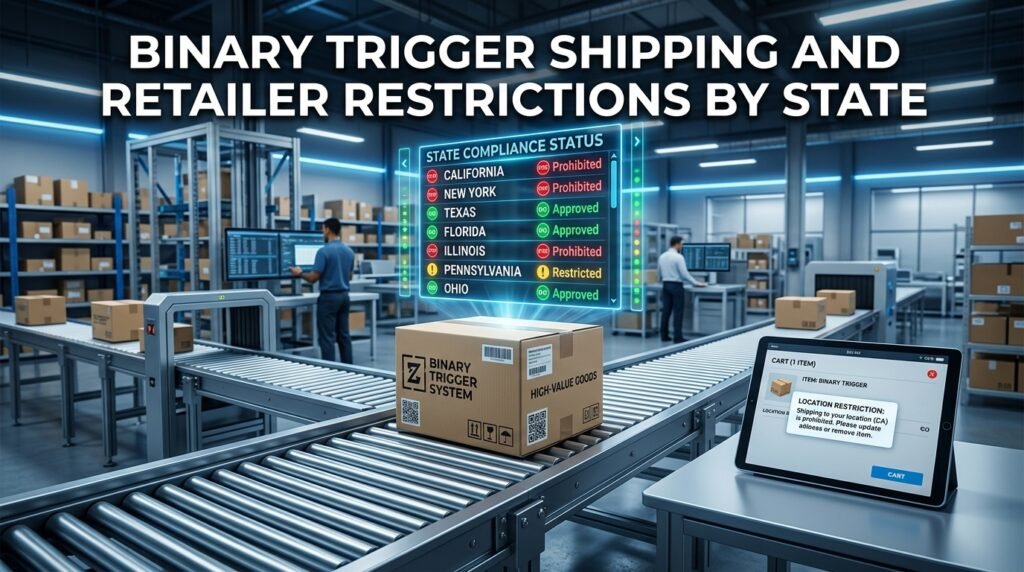
Even in states where binary triggers are legal to own, retailers won’t always ship there. Manufacturers track legal risk closely, and they’d rather block a sale than deal with a liability headache later. That’s exactly why Florida sees so few binary trigger shipments despite its ambiguous legal status. The same caution shows up in Washington, D.C., where the registration maze makes retailers nervous even though no statute names binary triggers directly.
Before you order, check three things: your state’s law, your retailer’s shipping policy for your state, and whether your local jurisdiction adds anything state law doesn’t already cover. City and county ordinances can restrict what state law allows, and that’s an easy detail to miss.
States Requiring FFL Transfer for Binary Triggers
Most binary triggers ship as standalone parts and don’t require an FFL transfer. But if you’re buying a complete host firearm with a binary trigger pre-installed, like the G-S173 slide assembly, that’s a firearm transfer, and it runs through your local FFL dealer just like any other gun purchase. States with stricter point-of-sale rules, including background check waiting periods, can add extra steps even for a legal accessory purchase. When in doubt, ask your FFL dealer directly. They’ll know your local requirements better than any national guide can.
Federal Baseline
Binary triggers are legal under federal law, plain and simple. They’re not classified as machine guns under 26 U.S.C. § 5845(b), and the ATF treats the trigger pull and the trigger release as two separate functions of the trigger. One round fires per function, which keeps binary triggers outside the National Firearms Act’s machine-gun definition entirely.
Cargill v. Garland, decided in 2024, dealt with bump stocks, not binary triggers, so it doesn’t touch this analysis. Federal legality is only half the picture, though. States can and do layer their own restrictions on top, which is exactly why this guide exists.
ATF Classification: Why Binary Triggers Aren’t Machine Guns
The ATF’s logic comes down to one distinction: what counts as a single “function of the trigger.” A true machine gun fires multiple rounds from one continuous trigger function; think holding the trigger back and letting the gun keep firing. A binary trigger requires two distinct actions, a pull and a release, to fire two rounds. Because each shot ties to a separate mechanical function, the ATF doesn’t classify binary fire control as automatic fire. That’s the whole ballgame at the federal level, and it’s why manufacturers can legally sell these parts nationwide, even though states can still write stricter rules of their own.
Frequently Asked Questions
Are Binary Triggers Legal in Texas?
Yes. Texas has no statute restricting binary triggers, and federal law backs that up since the ATF treats the pull and release as separate trigger functions. The Franklin Armory BFSIII and similar binary triggers are legal to own in Texas.
Is the Franklin Armory BFSIII Legal in Florida?
It’s legally ambiguous, not clearly legal. Florida Statute § 790.222 defines a prohibited bump-fire stock broadly enough that it might reach binary triggers, but no Florida court has actually ruled on the question, and manufacturers generally won’t ship binary triggers into the state. Treat a binary trigger as legally risky in Florida until a court or the legislature resolves it.
Does Washington Ban Binary Triggers?
Yes. The release-fired round places a binary trigger inside Washington’s machine-gun definition under RCW 9.41.010, which effectively bans it. Interestingly, Washington doesn’t ban forced reset triggers, which fire one round per pull instead.
Are Binary Triggers Legal in Minnesota?
Yes, as of 2026. Minnesota’s 2024 binary-trigger ban was struck down and severed in May 2026 for violating the state’s single-subject clause. That was a procedural ruling, not a Second Amendment decision so that the legislature could reintroduce a standalone ban later. For now, binary triggers remain lawful in Minnesota.
Are Binary Triggers Legal Under Federal Law?
Yes. A binary trigger fires once on the pull and once on the release, and the ATF treats those as two separate trigger functions, which keeps it outside the machine-gun definition in 26 U.S.C. § 5845(b). Federal legality doesn’t override state law, though. Twelve states plus two ambiguous jurisdictions restrict binary triggers regardless of federal status.
What Is the Legal Difference Between a Binary Trigger and a Forced Reset Trigger?
A binary trigger fires one round on the pull and a second on the release. A forced reset trigger fires one round per pull but resets mechanically faster than a standard trigger. States often treat these two devices completely differently. Washington bans binary triggers but not forced reset triggers. Nevada bans forced reset triggers but not binaries. Rhode Island names binary triggers directly while its forced reset trigger coverage remains contested. Always check the specific device class before you buy, since assuming one rule covers both can get you in legal trouble fast.
Related Coverage
- Best Binary Triggers 2026
- Binary Trigger Legal States Explained
- AR Super Safety Guide
- Pistol Brace Legal States
Free Range Resources
Want printable targets, drill cards, and reference sheets sent straight to your inbox? Subscribe for weekly guides and reviews covering everything from trigger law updates to build tutorials.
Tools
Builder, Build Templates, AR Builder, AR9 Builder, Precision Rifle Builder, Catalog, Deals, Merch, Compare, Logbook
Resources
Guides, Articles, Research, Printables, Quiz, About, Media Kit
Legal
Terms, Privacy, Disclosure, Refunds
Conclusion:
So, are binary triggers legal in Florida? The honest answer is: it’s murky. Florida hasn’t banned binary triggers by name. But the bump-fire-stock law could still reach them. No court has settled it yet. That’s why most sellers won’t ship binary triggers to Florida.
Federal law says binary triggers are fine. State law is where things get tricky. Are binary triggers legal in Nevada? Yes. Are binary triggers legal in NC? Also yes. Are binary triggers legal in Texas? Yes again. But binary-trigger laws change every year, so don’t assume yesterday’s answer still holds today.
Is a binary trigger legal where you live? Check your state’s statute first. Then talk to a licensed attorney before you buy. Florida owners especially should stay cautious until the law catches up.
are binary triggers legal in florida are binary triggers legal in florida are binary triggers legal in florida are binary triggers legal in florida are binary triggers legal in florida are binary triggers legal in florida are binary triggers legal in florida are binary triggers legal in florida are binary triggers legal in florida are binary triggers legal in florida are binary triggers legal in florida are binary triggers legal in florida are binary triggers legal in florida are binary triggers legal in florida are binary triggers legal in florida are binary triggers legal in florida are binary triggers legal in florida are binary triggers legal in florida are binary triggers legal in florida are binary triggers legal in florida are binary triggers legal in florida are binary triggers legal in florida are binary triggers legal in florida are binary triggers legal in florida are binary triggers legal in florida are binary triggers legal in florida are binary triggers legal in florida are binary triggers legal in florida are binary triggers legal in florida are binary triggers legal in florida are binary triggers legal in florida are binary triggers legal in florida