
Section 498A IPC: The Law Against Cruelty Towards Women
Say “498A” in any Indian courtroom and people know exactly what you mean. It’s the law against cruelty to a married woman by her husband or his family. Since July 1, 2024, though, you’ll find it under a new number.
This guide covers 498a ipc in bns from every angle. You’ll see what changed, what didn’t, and how the law works in real life. We’ll also cover bail, complaints, misuse, and what the accused can do.
Every IAS post explained, from SDM to Cabinet Secretary. See the full rank order, pay levels, and how promotions really work.
Table of Contents

- What Is Section 498A IPC?
- Key Essentials, Cruelty, Bail, Who Can Be Prosecuted, and Punishment
- Cruelty Under the Bharatiya Nyaya Sanhita, 2023
- Other Laws That Protect Women
- A Recent Case on Cruelty
- How to File a Complaint
- Evidence That Strengthens a Case
- 498A vs. the Domestic Violence Act
- Misuse, Quashing, and the Rights of the Accused
- FAQs
What Is Section 498A IPC?

Section 498A of the Indian Penal Code, 1860 punished a husband, or a relative of the husband, who subjects a married woman to cruelty. Parliament added it in 1983. The goal was simple. Too many women faced harassment at home, often over dowry, and the existing laws didn’t fit.
Today, the same offence lives in Section 85 of the Bharatiya Nyaya Sanhita, 2023. People still search for “section 498 a ipc” or “sec 498 a ipc,” so the old name sticks around. Don’t be surprised if lawyers, police, and even judges use both.
Key Essentials of Section 498A IPC
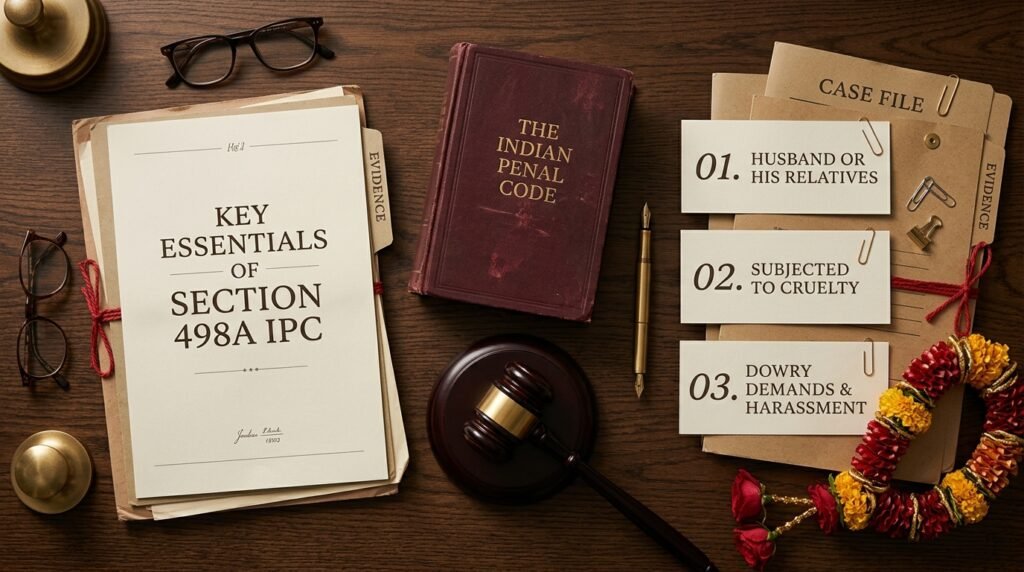
Here’s what you need to know in a nutshell:
- It protects married women only.
- The accused must be the husband or a relative of the husband.
- The offence is cognizable, non-bailable, and non-compoundable.
- It’s tried by a Magistrate.
- Dowry isn’t the only trigger. More on that below.
That last point trips up a lot of people. Some websites say cruelty must be tied to a dowry demand. That’s not quite right. A dowry-linked demand is one way to prove cruelty. Serious physical or mental harm is another.
What Counts as Cruelty? Mental vs. Physical Harassment

The law gives two broad meanings of cruelty. First, willful conduct that’s likely to push a woman toward suicide, or cause grave injury or danger to her life, limb, or health, mental or physical. Second, harassment meant to force her or her family to meet an unlawful demand for property or valuables, or harassment because they couldn’t.
Think of it this way. A husband who beats his wife regularly fits the first meaning. So does one who isolates her, threatens her, and constantly humiliates her until her mental health collapses. Meanwhile, in-laws who keep demanding a car or cash from her parents, and torment her when they refuse, fit the second. One bad argument or a rude comment, however, usually won’t meet the bar.
Is Section 498A Bailable? How Bail Works
No. The offence is cognizable and non-bailable. That means police can register an FIR and, in principle, arrest without a warrant. Bail isn’t a right here. A court has to grant it.
In practice, though, bail is common. The Supreme Court, in Arnesh Kumar v. State of Bihar (2014), told police not to arrest automatically in cases punishable by up to seven years. Officers must record reasons and often issue a notice to appear first. Also, if you fear arrest, you can apply for anticipatory bail under the Bharatiya Nagarik Suraksha Sanhita (BNSS), which replaced the old procedure code.
Who Can Be Prosecuted for Cruelty?
The husband, first of all. After that, his relatives can face charges, whether by blood, marriage, or adoption. That can include parents, siblings, and other family members.
There’s a limit, though. In U. Suvetha v. State (2009), the Supreme Court held that a husband’s girlfriend or concubine isn’t a “relative” under this section. Courts also warn against dragging in distant relatives with no real role. A sister-in-law living in another city who never visited, for example, will have a strong argument if the complaint names her without specifics.
Punishment Under Section 498A IPC
The 498a ipc punishment is imprisonment for up to three years, along with a fine. Courts decide the exact sentence based on how serious the cruelty was. The same applies to section 498a punishment under the new law. The BNS didn’t raise it or lower it.
It’s worth remembering that this section often appears next to others. If cruelty leads to a dowry death, Section 304B IPC (now Section 80 BNS) comes in. Abetment of suicide and the Dowry Prohibition Act can join the charge sheet too.
Cruelty Under the Bharatiya Nyaya Sanhita, 2023
Here’s the part everyone’s searching for. When the BNS came into force on July 1, 2024, the single IPC section split into two. Section 85 holds the offence and punishment. Section 86 holds the definition of cruelty.
| IPC | What It Covers | BNS | What Changed |
| Section 498A | Husband or relative subjecting a woman to cruelty | Section 85 | Wording and punishment carried over |
| Section 498A (Explanation) | Meaning of “cruelty” | Section 86 | Moved into its own section |
Notice what didn’t happen. No new safeguards against misuse. No change in bail status. In recent rulings, the Supreme Court has pointed out that the BNS version simply carries the old text forward, and it has urged lawmakers to consider the misuse concerns. Check for the latest guidance before you rely on this point in a published piece.
One more thing. The BNS applies only to conduct on or after July 1, 2024. Earlier cruelty, and cases already pending, continue under the IPC through the repeal and savings provisions.
Other Laws That Protect Women From Violence
Section 85 BNS isn’t the only tool. Women can also rely on:
- The Protection of Women from Domestic Violence Act, 2005, for civil relief like protection and residence orders.
- The Dowry Prohibition Act, 1961, which punishes giving, taking, and demanding dowry.
- The Sexual Harassment of Women at Workplace Act, 2013.
- BNS provisions on rape, stalking, and outraging modesty, which replaced the IPC sections people knew, like 376, 354D, and 509.
Which one fits depends on the facts. Often, more than one applies at once.
Recent Important Case on Cruelty
Consider Kahkashan Kausar v. State of Bihar (2022). A woman filed a complaint against her husband and several in-laws. Her allegations against the in-laws, however, were general and vague, with no dates, no specific acts, and no clear roles.
The Supreme Court quashed the proceedings against the in-laws. It said courts should watch for omnibus allegations in matrimonial disputes, because they can drag in whole families. However, the Court also stressed that real cruelty must never be brushed aside. The takeaway is simple. Specific details make a genuine complaint stronger.
How to File a Complaint for Cruelty
You’ve got several options. Walk into the nearest police station and ask to register an FIR. Visit a women’s cell or a special unit for women. Call 112 for emergencies, 181 for the women’s helpline, or 1091 for police support. You can also go to a Magistrate directly if the police won’t act.
Don’t wait for a “perfect” moment. If you’re in danger, call first, and sort out the paperwork later. Also, ask for a free copy of your FIR. You’re entitled to it, and you’ll need it later.
What Evidence Strengthens a 498A Case?
Courts look for proof, not just anger. Useful evidence includes:
- Medical records and photos of injuries.
- Messages, emails, and call logs showing threats or demands.
- Bank records showing payments made under pressure.
- Witness statements from neighbors, friends, or family.
- Earlier complaints to elders, the police, or a women’s helpline.
A quick example. If your in-laws demanded money repeatedly, screenshots of those chats and transfers will carry more weight than memory alone. Keep in mind that electronic records need proper certification to be accepted in court, so save the original device.
Section 498A vs. the Domestic Violence Act: Key Differences
These two laws solve different problems. Section 85 BNS is criminal. It punishes the offender with jail and a fine. The Domestic Violence Act is mostly civil. It gives a woman protection orders, a right to stay in the shared home, maintenance, and compensation.
Here’s why that matters. Say a woman wants safety and a roof over her head, but doesn’t want her husband jailed. The Domestic Violence Act may suit her better. If she wants criminal action for serious abuse, Section 85 is the route. Many women use both together.
Misuse of Section 498A: What the Courts Have Said
Let’s be honest. The law has been misused in some cases. The Supreme Court has said so more than once, and it has warned against using the section to settle personal scores or pressure families. Meanwhile, genuine victims still struggle to be believed. Both problems are real.
Courts have tried to strike a balance. They’ve asked police to avoid mechanical arrests, as in Arnesh Kumar. The Rajesh Sharma (2017) directions on Family Welfare Committees tried another route, but the Court set aside those directions in 2018, and later rulings have kept revisiting the topic. So the safe approach is simple: check current guidance before you rely on any single ruling.
Can a 498A Case Be Quashed or Compounded?
It can’t be compounded. The offence is non-compoundable, so the parties can’t simply agree to withdraw it. However, a High Court can quash an FIR or proceedings under its inherent powers, now found in the BNSS. Courts usually do this when a matrimonial dispute is genuinely settled and the offence doesn’t involve grave harm.
For example, a couple that reconciles, or agrees to a mutual divorce with a clean settlement, might approach the High Court together. The judge will still decide. Settlement helps, but it doesn’t guarantee quashing.
Rights and Legal Options for the Accused
Being named in a 498A complaint is stressful. Still, you have rights. Here’s what you can do:
- Stay calm and speak to a criminal lawyer right away.
- Ask whether you can apply for anticipatory bail.
- Insist on a notice to appear if the police follow the Arnesh Kumar approach.
- Collect your own evidence, like chats, travel records, and photos.
- Ask your lawyer about quashing if the allegations are vague or the case is settled.
One caution. Never pressure the complainant, delete evidence, or ignore a court summons. That can make things much worse.
FAQs
What is 498a ipc in bns?
498A IPC is now Section 85 BNS. Section 86 defines cruelty. Punishment is up to three years and a fine.
Is Section 85 BNS bailable?
No, it’s cognizable and non-bailable, but courts often grant bail, and you can also seek anticipatory bail before any arrest.
What is the 498a ipc punishment under the new law?
Imprisonment up to three years and a fine, exactly as before. The BNS didn’t raise or lower the penalty either.
Who can be charged under cruelty in IPC and BNS?
A husband or his relatives by blood, marriage, or adoption can be charged. A girlfriend or concubine isn’t covered.
Can a Section 85 BNS case be quashed after a settlement?
Sometimes. It’s non-compoundable, but a High Court can quash the FIR under inherent powers if the dispute is genuinely settled.
Where do I file a cruelty complaint under BNS?
Go to your nearest police station, a women’s cell, or call 112, 181, or 1091. You can approach a magistrate.
Does BNS apply to cruelty committed before July 1, 2024?
No. Earlier cruelty cases still proceed under the IPC. The BNS covers only conduct on or after July 1, 2024.
Conclusion:
The full picture is clear now. The old Section 498A lives in Sections 85 and 86 of the new code. If you came here searching for 498a ipc in bns, you’ve got your answer. The number changed. The core rule didn’t.
The 498a ipc punishment is still up to three years in jail and a fine. Section 498a punishment works the same way today. Many people still say section 498 a ipc or sec 498 a ipc, and that’s fine. Everyone knows what you mean. The offence also stays non-bailable, though courts often grant bail.
Cruelty in IPC cases was never a small matter, and it isn’t now. Women deserve protection. The accused deserve a fair hearing too. If you’re facing this situation, document everything and speak to a lawyer early. Stay informed, and you’ll feel far more in control.
498a ipc in bns 498a ipc in bns 498a ipc in bns 498a ipc in bns 498a ipc in bns 498a ipc in bns 498a ipc in bns 498a ipc in bns 498a ipc in bns 498a ipc in bns 498a ipc in bns 498a ipc in bns 498a ipc in bns 498a ipc in bns 498a ipc in bns 498a ipc in bns 498a ipc in bns 498a ipc in bns498a ipc in bns