
You miss your exit on the expressway. Your instinct says back up. But should you? Knowing when it is legal to back up on an expressway matters more than you think. Traffic moves fast on these roads. One wrong move can cause a serious crash.
Here’s the short answer. Backing up on a highway is almost always illegal. So when is it legal to back up on an expressway? Only in a true emergency. Even then, state laws set strict limits. Break that rule. You risk a costly citation.
This guide answers when it is legal to back up on an expressway in plain terms. You’ll learn what the law says. You’ll also learn what to do if you miss your exit instead. No legal jargon here. Just clear, simple facts. Keep reading closely. The real answer might surprise you.
Hit by an 18-wheeler in Nashville? An accident attorney who fights trucking companies daily. Free case review, no fee unless you win.
When is it legal to back up on an expressway? Community Answer

Quick take: never. That’s the short version drivers give every time this question comes up on forums and Q&A boards. No exceptions, no gray area. If you miss your exit on an expressway, backing up isn’t an option worth risking.
Why This Is the Correct Answer

Here’s why option A wins every time. Expressway traffic doesn’t slow down for mistakes. Cars behind you close distance at 65, 70, sometimes 80 miles an hour. Put your car in reverse for even a second. You’ve just turned a routine drive into a collision waiting to happen.
Option B tempts a lot of drivers. You see your exit fly by. Your gut says just back up a little. But that instinct gets people killed. Option C sounds reasonable too — surely an emergency changes things? It doesn’t. Even in an emergency, the correct move is to pull over and stop, not throw your car into reverse on a live expressway. So option D, “none of the above,” doesn’t hold up either. The answer stays simple: never.
Textbook & Expert-Verified Answer

Every state driver’s manual agrees on this point. Backing up on an expressway ranks among the most dangerous maneuvers a driver can attempt, and driver’s education programs teach it as a hard rule, not a judgment call. State vehicle codes across the country treat reverse driving on a highway as a moving violation, plain and simple. If you’re studying for a driving test question like this one, remember it this way: forward is the only direction that’s ever legal on an expressway, except when you’re safely exiting.
The Full Explanation
Expressways get built for one direction of travel: forward, and fast. Engineers design on-ramps, exit ramps, and shoulders around that assumption. The moment you put your car in reverse, you break every expectation the drivers around you are working with.
Think about it from the other driver’s perspective. You’re cruising at highway speed, eyes scanning ahead, brain assuming nothing in front of you moves backward. Then it does. You don’t have time to process what’s happening, let alone react. That’s the core problem with reversing on a freeway — it violates the basic logic the whole road system runs on.
Weather, traffic density, and visibility all make backing up worse, not better. Rain cuts stopping distance. Fog hides your car from view. Rush-hour traffic packs cars closer together, leaving zero cushion for a mistake. None of these factors make backing up safer under any circumstance.
Is It Ever Safe to Back Up on a Highway?
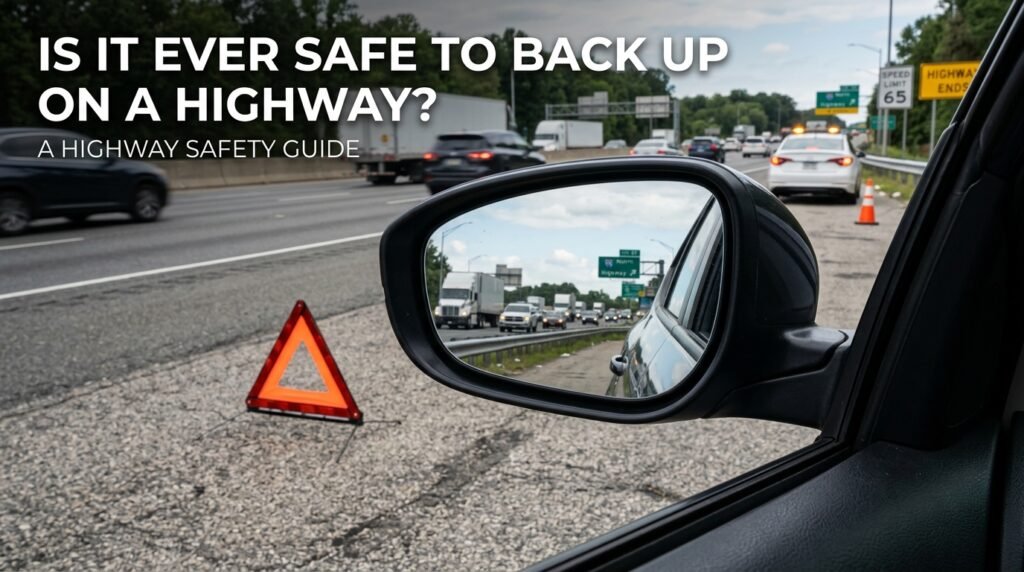
Short answer: no. Even trained emergency responders avoid backing up on a live expressway unless they’ve fully closed the lane first. For an everyday driver, there’s no version of this maneuver that counts as safe. If your car breaks down or you miss a turn, the safer move is always forward progress or a complete stop, never reverse.
Real-World Examples & Evidence
Highway patrol officers see the same pattern again and again. A driver misses an exit, panics, and reverses for just a few seconds. That’s usually all it takes for the car behind to slam into them at full highway speed. These aren’t rare freak accidents — they’re predictable outcomes of an entirely preventable decision.
Driver’s ed instructors use this exact question as a teaching moment because it exposes a common gap in judgment. Students often know the rule technically. But the instinct to correct a missed exit runs strong. Recognizing that instinct — and overriding it — is half the lesson.
Backing Up vs Missing Your Exit: What’s the Difference?
Missing your exit costs you time. Backing up to fix it risks your life. That’s the entire comparison in one sentence.
Take the inconvenience seriously, sure. Nobody enjoys driving five extra miles to the next exit and looping back. But weigh that against the alternative: a rear-end collision at highway speed, a traffic citation, or worse. The math isn’t close.
What the Law Says About Backing Up on Expressways and Freeways
State vehicle codes vary in their exact wording. But the underlying rule stays consistent nationwide. Backing up on a freeway or expressway counts as a traffic violation almost everywhere. Many states classify it specifically under laws that prohibit reverse driving on controlled-access highways.
Law enforcement officers who witness this maneuver don’t need much discretion to issue a citation. The violation is visible, obvious, and easy to document. Depending on the state, backing up on a highway might get charged as a straightforward moving violation. Or it could escalate to reckless or careless driving if it puts other vehicles at risk. Since state traffic codes differ, checking your own state’s driver’s manual gives you the exact legal language that applies where you drive.
What to Do Instead If You Miss Your Exit
Missing your exit isn’t a crisis. Here’s what actually works instead of reversing:
- Keep driving forward until you reach the next exit.
- Use that exit to loop back toward your original destination.
- Turn on your GPS the moment you realize you’ve missed the turn, so it can reroute you before you even get there.
- If your car breaks down or you’re facing a real emergency, pull onto the shoulder or emergency lane, turn on your hazard lights, and call for help.
- Never treat reversing as a shortcut, even if the next exit looks miles away.
Every one of these options keeps you moving in the direction traffic expects. That’s the whole point.
Penalties for Illegally Reversing on a Highway or Expressway
Penalties for backing up on an expressway differ by state. But they typically follow a similar pattern. Expect a traffic citation and fine at minimum. Many states also add points to your driving record, which can raise your insurance rates for years afterward.
If the reversing maneuver causes a crash, the penalties climb fast. You could face charges for reckless driving. And if anyone gets hurt, the legal consequences get considerably more serious. Insurance companies also tend to treat this kind of violation harshly, since backing up on a highway signals a level of risk they don’t like underwriting. Check your specific state’s vehicle code for exact fine amounts and point values, since these numbers shift from state to state.
Related Expressway and Highway Driving Test Questions
This isn’t the only trick question drivers face on a written exam. A few others come up just as often:
- What should you do if you miss your exit? Continue to the next one and turn around safely.
- Is it legal to stop on the shoulder of an expressway without a valid reason? No, that usually violates traffic law too.
- Can you use the emergency lane to pass slow traffic? No, that lane exists strictly for emergencies and disabled vehicles.
- What’s the safest action if you enter an expressway going the wrong direction? Pull over immediately, turn on your hazard lights, and call for help instead of attempting a U-turn.
Studying these together builds the same instinct: forward progress and complete stops are almost always safer than any reverse or improvised maneuver on a controlled-access highway.
Have a Question About This Topic? Ask the Community
Still unsure about a specific driving law in your state? Questions like this trip up plenty of learners. You’re not the only one wondering. Drop your question below. Let’s work through it together.
Free Driver’s Education Solutions and Answers
Looking for more help with driver’s education material? You’ll find straightforward answers to common permit test questions, state-specific traffic law breakdowns, and practical driving tips, all written in plain English without the legal jargon.
New Questions in Driver’s Education
- What’s the proper following distance on a highway at higher speeds?
- When should you use your hazard lights while driving?
- Is it legal to drive with only your parking lights on at night?
- What should you do if your brakes fail on an expressway?
Conclusion:
So, when is it legal to back up on an expressway? Almost never. The only safe answer is: don’t do it. Pull forward instead. Take the next exit. That’s the rule that keeps you safe.
Knowing when is it legal to back up on an expressway isn’t just test trivia. It’s a real safety habit. Highway speeds don’t leave room for mistakes. One wrong reverse move can cause a serious crash in seconds.
Next time someone asks when is it legal to back up on an expressway, you’ll know the answer. Never risk it, not even for a missed exit. Stay calm. Keep driving forward. Use the next exit to turn around. That one small habit could save your life, and someone else’s too.
When is it legal to back up on an expressway When is it legal to back up on an expressway When is it legal to back up on an expressway When is it legal to back up on an expressway When is it legal to back up on an expressway When is it legal to back up on an expressway When is it legal to back up on an expressway When is it legal to back up on an expressway When is it legal to back up on an expressway When is it legal to back up on an expressway